By KidsDirect Editorial Team
Stages of Labor
For about nine months, your baby has been growing in the womb. Now it’s time to meet them. Labor is the series of steps your uterus goes through to push your baby out, and it usually begins close to your due date. It can start a few weeks early or a little late, and no two labors look alike. Knowing the basics helps you feel ready instead of rattled. Here’s what happens, in the order it usually happens.
What Starts Labor
Nobody knows for sure. Hormones made by you and your baby play a part, and so do changes in your uterus. The muscles of the uterus begin to tighten and release in waves called contractions. These contractions slowly open the cervix, which is the doorway at the bottom of your uterus. As it opens, called dilating, it also thins out, which is called effacing. Once it’s fully open, your baby can move down and out.
Signs Labor Is Getting Close
Your body often gives hints before the real thing begins. Some show up weeks ahead, and some only hours before.
Lightening
This is when your baby drops lower into your pelvis. You may notice your clothes fit differently. Breathing often gets easier, but you may need the bathroom more. It can happen a few weeks or a few hours before labor.
Bloody Show
During pregnancy, a thick plug of mucus seals your cervix. As the cervix softens and opens, the plug comes out. You may see clear, pink, or slightly bloody mucus. This can happen up to a few days before labor, or when it starts.
Your Water Breaking
The bag of water around your baby can leak or break. You may feel a slow trickle or a sudden gush of warm fluid. It can happen hours before labor or at any point during it, and in many births it’s one of the later signs. Call your provider when it happens, even if you aren’t having contractions yet.
Braxton Hicks Contractions
These practice contractions are sometimes called false labor. You’ve probably felt them already. As your due date gets closer they can get stronger. The difference is that Braxton Hicks usually ease up when you walk, rest, or change position, while true labor contractions keep coming, grow stronger, and get closer together. True labor pain often starts in the back and wraps around to the front, and Braxton Hicks is usually felt only in the front. Our page on Braxton Hicks contractions has more on telling them apart.
How Long Does Labor Take
It depends, and the answer is often longer than people expect. Early labor, when the cervix opens up to about 6 centimeters, can take many hours and sometimes more than a day with a first baby. The American College of Obstetricians and Gynecologists (ACOG) says that an early phase lasting more than 20 hours for a first-time mom, or more than 14 hours for a mom who’s given birth before, shouldn’t be a reason for a cesarean by itself. Once you reach about 6 centimeters, you’re in active labor, and things tend to move faster. Labor is usually quicker for moms who’ve given birth before.
When to Go to the Hospital
Many providers use the 5-1-1 rule. Head in when your contractions come about every 5 minutes, last about a minute each, and have kept that pattern for at least an hour. Some providers prefer 4-1-1, so ask which rule yours uses. You can read more about what to pack in our labor checklist.
Go right away, or call your provider, if your water breaks, if you have bleeding, or if you feel a strong urge to push. Call too if your baby seems to be moving less than usual, or if you aren’t sure what you’re feeling. No one will mind the call. Some parents choose a home birth with a midwife. Because some births need extra help, doctors usually advise being at a hospital or birth center unless a home setup has everything needed for an emergency.
First Stage
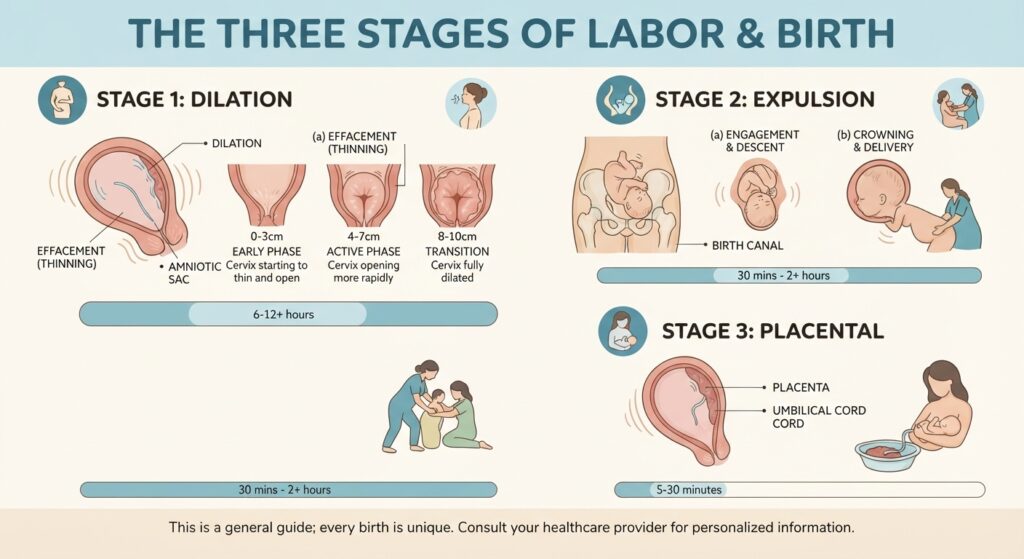
The first stage starts with the first real contractions and ends when your cervix is fully open at 10 centimeters. It’s the longest stage. Contractions begin gentle and spaced far apart, then grow stronger, longer, and closer together. In active labor they tend to come every 3 to 4 minutes and last about a minute each. You may also notice back pain, nausea, or leg cramps.
This is a good time to use whatever helps you cope. Walking, changing positions, a warm shower, slow breathing, and a steady support person can all take the edge off. If you want medication for pain, ask your provider about your options. Putting your preferences in writing ahead of time makes it easier, and our guide to making a birth plan shows how.
Second Stage
The second stage begins when your cervix is fully open and ends when your baby is born. This is the pushing stage. You’ll use your abdominal muscles along with each contraction to help your baby move down the birth canal. ACOG says it’s reasonable to allow first-time moms to push for at least three hours, and about an hour longer with an epidural, as long as progress continues. For moms who’ve given birth before, at least two hours is reasonable.
Your position matters. Many people find that squatting, kneeling, side lying, or leaning forward feels better than lying flat on the back. Ask your care team what’s possible. At the end of this stage, your baby is born, and you’ll likely get to hold them skin to skin right away. Our ultimate breastfeeding guide covers that first feed.
Third Stage
After your baby arrives, your uterus keeps contracting to push out the placenta, the organ that fed your baby during pregnancy. This usually happens within about 30 minutes. The placenta and the membranes that surrounded your baby are called the afterbirth. Your provider will check that it’s all been delivered and will help your uterus stay firm to limit bleeding.
What if Your Baby Isn’t Head Down
Most babies settle into a head down position before birth, which is the easiest way to come out. A small number, about 3 or 4 out of every 100, are breech, meaning the bottom or feet are down. Your provider may try to turn the baby, or may recommend a cesarean birth, since the head is the hardest part to deliver. Talk about your options early.
When a Cesarean Birth Is Needed
Sometimes a vaginal birth isn’t possible or isn’t the safest choice. Problems with the placenta, the umbilical cord, the baby’s heart rate, or the baby’s position can lead to a cesarean, which is surgery to deliver your baby through an incision in your belly. It’s common. The CDC reports that 32.4 percent of U.S. births were cesareans in 2024, or close to 1 in 3. Our C-section guide explains what to expect and how recovery goes.
Having one cesarean doesn’t always mean you’ll need another. Many women can try a vaginal birth next time, which is called a trial of labor after cesarean. Ask your doctor whether it’s an option for you. If you have gestational diabetes, your delivery timing may be a little different, and our page on gestational diabetes explains why.
Choosing Who Helps You
The people with you in labor matter. Whether you choose an OB, a midwife, or a doula, ask early what their approach is. Our page on picking the right caregiver for your baby’s birth can help you decide.
After the Birth
Your body has done something huge, and it will be sore for a while. If you’re hurting after delivery, our page on caring for your body after birth has tips for easing the soreness and healing.
Questions Parents Ask
What if my water breaks but I don’t have contractions?
Call your provider. Labor often follows within hours, but your doctor or midwife will tell you when to come in, since there’s a small infection risk once the water has broken.
How can I tell real contractions from Braxton Hicks?
Time them. Real contractions get stronger and closer together, and they don’t go away when you walk or rest. If you aren’t sure, call.
Will my labor be like my mom’s or my friend’s?
Maybe, maybe not. Every labor is different, and even your own labors can differ from one baby to the next.
Worth knowing. This page is general guidance and can’t replace the advice of your own doctor or midwife, who knows your health and your pregnancy. For more to read, browse our pregnancy section.