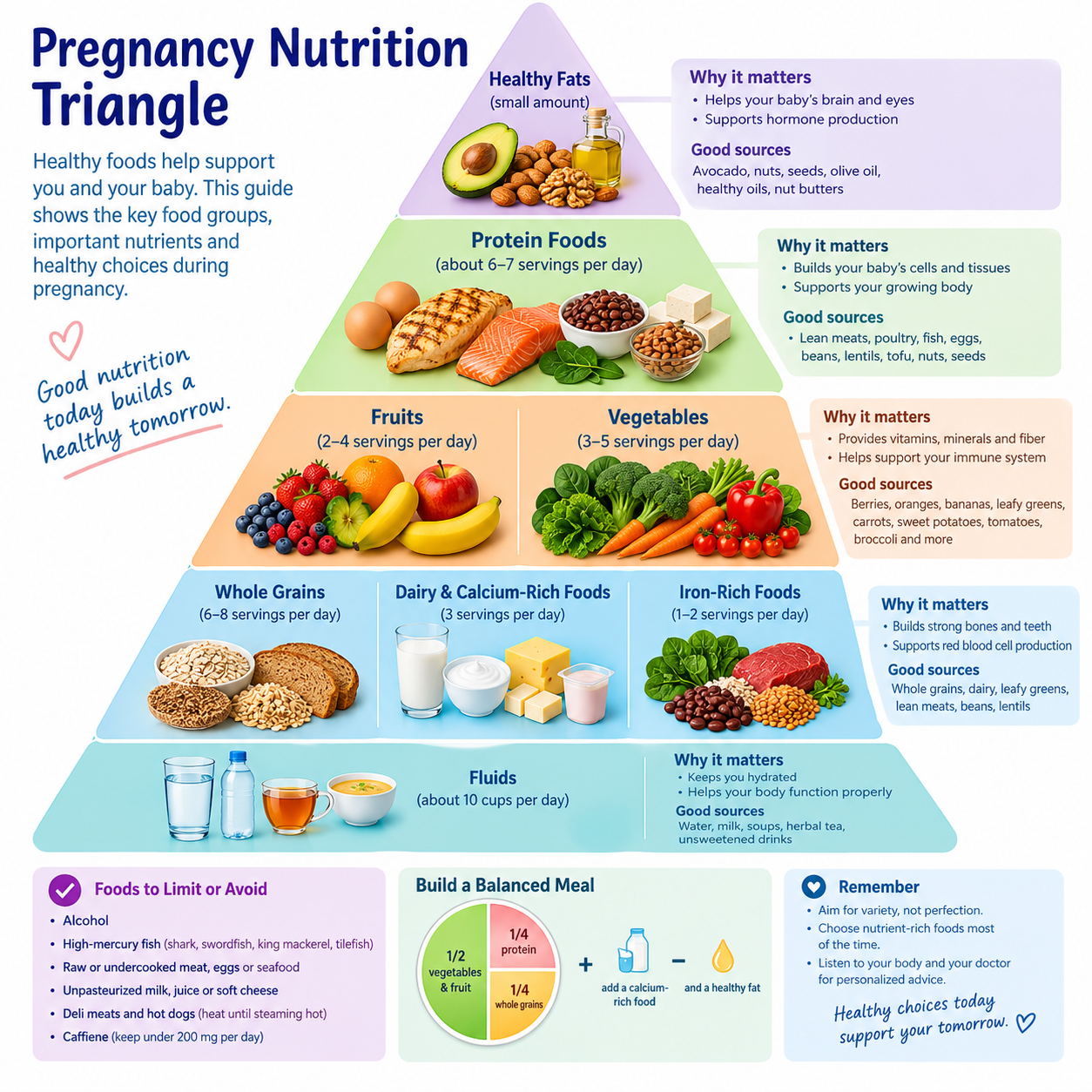
What you eat while you’re pregnant does more than keep you comfortable, it’s one of the main ways you’re already parenting. The good news is that eating well for pregnancy isn’t nearly as complicated or as restrictive as a lot of old advice makes it sound. Below is what actually matters, what you can stop worrying about, and where a lot of the internet gets it wrong.
The nutrients that matter most
You don’t need to hit a perfect number on all of these every single day. Think of this as the short list worth knowing, not a checklist to obsess over.
Folate. This is the one doctors talk about most, because getting enough early on lowers the risk of neural tube defects like spina bifida. Aim for about 600 micrograms a day during pregnancy, and ideally start before you conceive since the neural tube forms in the first few weeks, often before you even know you’re pregnant. Leafy greens, beans, citrus, and fortified grains all help, but this is one nutrient most doctors want you supplementing regardless of how well you eat.
Iron. Your blood volume expands a lot during pregnancy, and iron is what keeps up with it. The target is 27 milligrams a day, roughly double what you needed before pregnancy. Red meat, beans, spinach, and fortified cereals all have it, and pairing iron rich foods with a source of vitamin C helps your body absorb it better.
Calcium and vitamin D. Your baby is building an entire skeleton, and calcium is the raw material. Most pregnant adults should get around 1000 milligrams of calcium a day, dairy, fortified plant milks, and leafy greens are all good sources, and vitamin D (about 600 IU, or 15 micrograms) helps your body actually use it.
DHA. This omega-3 fat is a major building block for your baby’s brain and eyes. Most guidance points to at least 200 milligrams a day, which you can get from low mercury fish like salmon or sardines a couple times a week, or from an algae based supplement if you don’t eat fish.
Choline and iodine. These two get far less attention than they deserve. Choline (about 450 milligrams a day, found in eggs and lean meat) supports your baby’s brain development, and iodine (220 micrograms a day) is essential for thyroid function for both of you. Check that your prenatal vitamin actually includes iodine, quite a few don’t.
| Nutrient | Daily Goal During Pregnancy | Good Food Sources |
|---|---|---|
| Protein | About 71 g | Eggs, chicken, turkey, fish, beans, lentils, Greek yogurt, nuts |
| Folate / Folic Acid | 600 mcg DFE | Leafy greens, beans, oranges, avocado, fortified grains |
| Iron | 27 mg | Lean beef, poultry, beans, lentils, spinach, fortified cereals |
| Calcium | 1,000 mg | Milk, yogurt, cheese, calcium-fortified milk, tofu |
| Vitamin D | 600 IU (15 mcg) | Fortified milk, eggs, fatty fish, fortified foods |
| Iodine | 220 mcg | Iodized salt, dairy products, eggs, seafood |
| Choline | 450 mg | Eggs, beef, chicken, soybeans, potatoes |
| Vitamin C | 85 mg | Oranges, strawberries, kiwi, peppers, broccoli |
| Vitamin B12 | 2.6 mcg | Meat, fish, eggs, milk, fortified foods |
| Vitamin A | 770 mcg RAE | Sweet potatoes, carrots, spinach, eggs, dairy |
| Fiber | 28 g | Fruits, vegetables, beans, whole grains, nuts |
| Fluids | About 10 cups daily | Water, milk, soups, unsweetened drinks |
About your prenatal vitamin
Here’s something worth saying plainly, because it’s been the subject of some genuinely bad advice for years. A standard prenatal vitamin containing iron is not dangerous, and the nausea some women feel after taking one isn’t your body “protecting” you from something toxic. It’s a common, well documented side effect of iron supplements in general, pregnant or not, and it’s manageable.
If your prenatal is upsetting your stomach, try taking it with food instead of on an empty stomach, splitting the dose if your doctor is fine with that, or taking it right before bed. Some women do better switching to a different iron formulation. What you shouldn’t do is stop taking it altogether or avoid iron supplementation without talking to your doctor first, since iron deficiency anemia during pregnancy is common and worth preventing.
One more thing worth knowing, more supplementation isn’t automatically better. Some vitamins and minerals have a real upper limit where more stops helping and starts causing problems, magnesium, zinc, and selenium are three that people sometimes over supplement without realizing there’s a ceiling. Your prenatal vitamin is formulated with pregnancy in mind. Adding a bunch of extra standalone mineral supplements on top of it, especially at high doses, is more likely to cause harm than good. If you think you’re low on something specific, that’s a conversation for your doctor or a blood test, not a reason to start stacking supplements on your own.
Foods and drinks worth being careful with
This list is shorter than a lot of pregnancy sites make it sound, and it’s grounded in actual infection and contamination risk rather than general food fear.
Raw or undercooked meat, poultry, seafood, and eggs. This covers sushi made with raw fish, rare meat, soft cooked or raw eggs (think homemade Caesar dressing or raw cookie dough), and anything with unpasteurized egg. The concern is foodborne illness, and pregnancy makes those infections harder on your body.
Deli meat, hot dogs, and refrigerated pâté. These carry a small but real listeria risk unless they’re heated until steaming hot first. Listeria is rare, but it’s dangerous enough in pregnancy that it’s worth the extra step.
Unpasteurized dairy and juice. Soft cheeses like brie, feta, and blue cheese are fine as long as they’re made with pasteurized milk, which most sold in the US are. Check the label if you’re not sure.
High mercury fish. Swordfish, shark, king mackerel, marlin, orange roughy, and bigeye tuna all carry enough mercury to affect a developing nervous system. Lower mercury options like salmon, shrimp, and canned light tuna are fine in normal amounts, and you shouldn’t cut fish out entirely since the DHA benefit is worth keeping.
Raw sprouts. Alfalfa, clover, and mung bean sprouts can harbor bacteria that’s hard to wash off, since it can get inside the seed itself before it even sprouts.
Alcohol. There’s no amount that’s been shown safe during pregnancy, so the standard advice is none, at any point.
Caffeine. Under 200 milligrams a day, which is roughly one 12 ounce cup of coffee, is generally considered fine. That total adds up fast once you count tea, soda, and chocolate too.
A few myths worth retiring
Pregnancy nutrition advice has picked up a lot of baggage over the years, some of it decades old and never updated. A few worth clearing up.
“Eating for two” means double the food. It doesn’t. Most pregnant women only need a modest calorie increase, often none at all in the first trimester and only a few hundred extra calories a day by the third. It’s about the quality of what you’re eating a lot more than the quantity.
Mostly raw food is the healthiest way to eat while pregnant. This one’s actually backwards. Pregnancy is exactly the time to be more careful about raw food, not less, since your risk from foodborne illness is higher than usual. Cooked, well washed, and pasteurized are the priorities here, not raw.
Dairy causes mucus and breathing problems in newborns. This idea has been tested directly and it doesn’t hold up. Milk doesn’t increase mucus production in controlled studies, in babies or anyone else.
Ginger is unsafe for morning sickness. Ginger has actually held up well in research as a safe, effective option for nausea in normal food and tea amounts. If anything, it’s one of the better studied home remedies out there.
You need to megadose vitamins to cover the bases. A balanced diet plus a standard prenatal vitamin covers the vast majority of what you need. Piling on extra standalone supplements, especially at multiples of the recommended amount, adds risk without adding benefit.
Making it simple day to day
You don’t need a meal plan taped to your fridge. A few habits do most of the work, eating regularly enough that you’re not running on empty (small frequent meals help a lot if nausea is an issue), getting some protein and produce at most meals, drinking enough water that your urine runs pale, and not stressing over one bad day or one skipped vegetable. Pregnancy nutrition is a pattern over weeks and months, not a report card on any single meal.
Pregnancy Nutrition FAQ
The questions we hear most about eating well, supplements, and what's actually worth worrying about.
Do I really need a prenatal vitamin if I eat well?
Most doctors say yes, even for women eating a genuinely good diet. Folate is the main reason, since the amount recommended in pregnancy is hard to reliably hit through food alone, and the window where it matters most is often before you know you’re pregnant. Think of the vitamin as a backstop for the nutrients that are easy to fall short on, not a replacement for eating well.
My prenatal vitamin makes me nauseous. Is it hurting my baby?
No. Nausea from a prenatal vitamin is almost always the iron in it, and it’s a known, common side effect, not a sign of harm. Taking it with food, splitting the dose, or switching formulations with your doctor’s input usually helps. Stopping it altogether isn’t the fix, since iron deficiency during pregnancy is common and worth avoiding too.
How much caffeine can I actually have?
Under 200 milligrams a day is the commonly cited limit, which works out to about one 12 ounce cup of coffee. Tea, soda, energy drinks, and chocolate all count toward that total too, so it adds up faster than most people expect.
Can I eat sushi while pregnant?
Cooked sushi rolls are fine. Anything with raw fish, like sashimi or traditional nigiri, carries a foodborne illness risk that’s not worth taking during pregnancy. Cooked options like shrimp tempura or a California roll made with real cooked crab are easy substitutes if you’re craving it.
What about deli meat and soft cheese?
Deli meat and hot dogs are fine if you heat them until steaming hot first, which handles the small listeria risk they carry cold. Soft cheeses like brie and feta are fine as long as they’re made with pasteurized milk, which covers the large majority sold in stores. Check the label if you’re buying from a specialty counter.
Is it true I need to eat for two?
Not in the way people usually mean it. Calorie needs barely change in the first trimester and only go up by a few hundred calories a day by the third. What matters more is what’s on the plate, protein, produce, whole grains, than how much of it there is.
Is ginger safe for morning sickness?
Yes, in normal food and tea amounts. It’s one of the more well studied natural options for nausea in pregnancy and has held up as both safe and reasonably effective. If your nausea is severe enough that ginger isn’t cutting it, that’s worth bringing up with your doctor rather than pushing through it.
Do I need to take a separate DHA or fish oil supplement?
If you eat low mercury fish like salmon or sardines a couple of times a week, you’re likely covering it through food. If you don’t eat fish, an algae based DHA supplement is a solid option, and it’s the same source fish get their DHA from in the first place.
I’m vegetarian or vegan. What should I pay closest attention to?
Iron, vitamin B12, choline, and DHA are the ones that take a bit more planning without meat, dairy, or eggs in the picture. A good prenatal vitamin covers most of the gap, and an algae based DHA supplement handles the omega-3 piece that would otherwise come from fish. Your doctor can check your levels if you want more specific reassurance.
Can I still have an occasional cup of herbal tea?
It depends on the herb, and this is one area where “natural” doesn’t automatically mean “fine in pregnancy.” Some herbal teas haven’t been well studied for pregnancy safety, and a few are actively discouraged. Ask your doctor before making any herbal tea a regular habit, and treat labels that say “pregnancy tea” or “nursing tea” the same way, by checking with your provider rather than assuming the label means it’s been vetted.
Do I need to cut out dairy to avoid a fussy or congested newborn?
No. The idea that milk causes mucus or breathing problems has been tested directly in controlled studies and it doesn’t hold up. Unless you or your baby has an actual dairy allergy or intolerance, there’s no nutritional reason to avoid it.
No questions match your search.
If you’re tracking how your body’s changing alongside all of this, our pregnancy weight gain chart breaks down healthy ranges by starting weight, and our full lineup of pregnancy and prenatal tools covers due dates, weekly development, and a lot more, all free to use.