By KidsDirect Editorial Team
SIDS and Safe Sleep
Few things scare new parents more than the thought of losing a baby in their sleep. That fear is understandable. The good news is that you have real control over how your baby sleeps, and a handful of simple habits lower the risk a great deal. This page explains what SIDS is, what raises the risk, and the steps pediatricians recommend for every nap and every night.
What SIDS Is
Sudden infant death syndrome, or SIDS, is the sudden death of a baby under one year old that stays unexplained even after a full investigation. SIDS belongs to a bigger group called sudden unexpected infant death, or SUID. That group also includes deaths from accidental suffocation in bed and deaths with no clear cause.
The numbers help put it in perspective. The CDC reports that about 3,400 babies in the United States died suddenly and unexpectedly in 2024. Roughly 1,350 of those were SIDS, about 1,100 had an unknown cause, and about 950 were accidental suffocation or strangulation in bed. Most of these deaths happen in the first six months, and the risk peaks between one and four months.
Why It Happens
Nobody knows the exact cause. Experts think SIDS happens when a vulnerable baby meets a risky sleep situation at a delicate stage of development. A baby may have a small problem in the brain’s ability to wake up or respond to low oxygen. If that baby is also face down, under a blanket, or too warm, the combination can be deadly. You can’t see the vulnerability. You can control the sleep setting, and that’s why safe sleep advice focuses there.
The Safe Sleep Basics
The American Academy of Pediatrics (AAP) updated its safe sleep advice in 2022. Here’s what it boils down to.
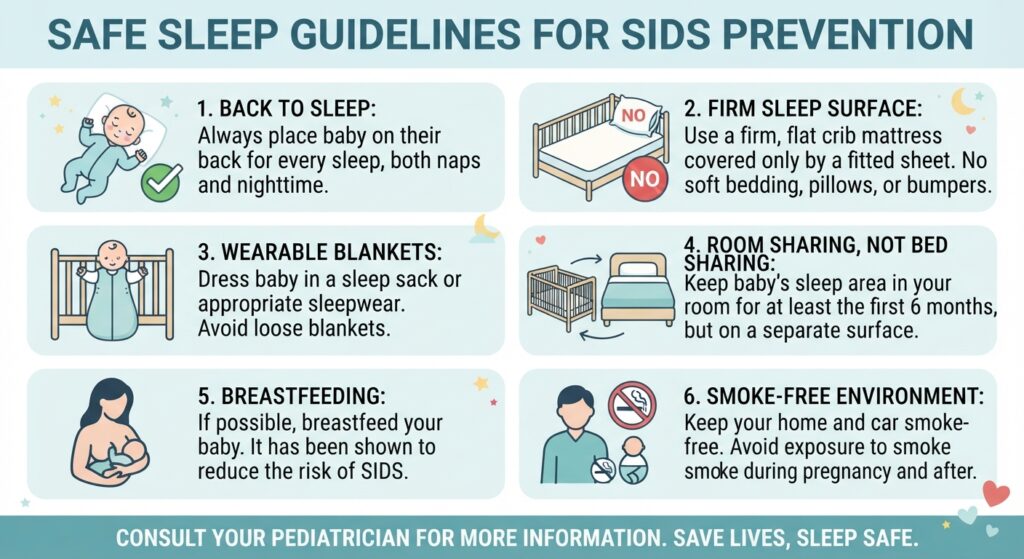
Put your baby on the back for every sleep, naps included. Back sleeping is the single biggest step you can take. Use a firm, flat surface that’s made for babies, such as a crib, bassinet, or play yard with a fitted sheet and nothing else. That means no pillows, blankets, bumper pads, or stuffed animals. Soft surfaces and loose items can block your baby’s breathing. Skip inclined sleepers too, since a flat surface is safer. Sleep surfaces tilted more than about 10 degrees are considered unsafe.
Keep your baby’s sleep space in your room, close to your bed, for at least the first six months. This is called room sharing, and it’s linked to a lower risk. Your baby sleeps on a separate surface right next to you. Our page on sleeping with your baby covers the question of sharing a bed.
Dress for Sleep, Not for Winter
Overheating raises the risk, so skip the heavy layers. A light sleeper or a wearable blanket, often called a sleep sack, works better than loose blankets. If you aren’t sure about your baby’s temperature, feel the back of the neck, which should feel warm but not sweaty. Our guide to dressing your baby to stay warm explains how. Don’t cover your baby’s head or face during sleep.
Breastfeeding, Pacifiers, and Vaccines
Three more habits are linked to lower risk. Any amount of breastfeeding helps, and more helps more, so see our ultimate breastfeeding guide if you’re getting started. Offering a pacifier at sleep time may also lower the risk once breastfeeding is going well. If it falls out, you don’t need to put it back in. Skip clips or cords that attach it to your baby. Keep up with routine vaccines, which are linked to lower SIDS risk too.
Keep Your Baby’s World Smoke Free
Smoke is one of the strongest risk factors. Don’t smoke during pregnancy, and don’t let anyone smoke around your baby, in the house, in the car, or on clothing that smells of smoke. The AAP also advises avoiding alcohol, marijuana, and other drugs during pregnancy and after birth. If quitting feels hard, ask your doctor for help. It’s one of the best things you can do for your baby.
Swaddling, Car Seats, and Monitors
Swaddling is okay if you do it right. Use a thin blanket, keep it loose enough around the chest to fit two or three fingers, and let the hips move freely. Always lay your baby on the back, and stop swaddling as soon as your baby shows signs of trying to roll. Never use weighted swaddles.
Car seats, strollers, swings, and slings are for travel and awake time, not for sleep. A baby who dozes off in one should be moved to a flat, firm surface as soon as you arrive. Our guide to car safety for infants covers using the seat correctly. And don’t count on home monitors that claim to prevent SIDS. They haven’t been shown to lower the risk, so safe sleep habits matter more than any gadget.
Who’s at Higher Risk
Some babies face a higher risk. Premature babies and babies born at a low birth weight are among them, along with boys and babies exposed to smoke. Having a higher risk doesn’t mean it will happen, and it doesn’t mean you did anything wrong. It does mean safe sleep matters even more for your baby, and your doctor can talk with you about it.
Questions Parents Ask
When can my baby sleep on the stomach?
Always start on the back. Once your baby can roll from back to belly and from belly to back on their own, you don’t need to flip them back. Keep the crib bare, though.
Is tummy time safe?
Yes, and it’s recommended while your baby is awake and you’re watching. Start soon after you leave the hospital. It builds strength and helps prevent flat spots on the head.
My baby fell asleep on the couch or in a swing. What now?
Move your baby to a flat, firm sleep surface right away, on the back. One slip doesn’t mean something terrible will happen. What matters is the habit you build.
Can I use a crib bumper?
No. Bumpers don’t prevent injuries in a meaningful way and they can block breathing.
If You’ve Lost a Baby
If you or someone you love has lost a baby to SIDS, please know it wasn’t anyone’s fault. Grief like this is heavy, and you don’t have to carry it alone. Your doctor or hospital can connect you with a grief counselor or a support group for families who’ve been through the same thing.
Worth knowing. This page is general guidance and can’t replace advice from your baby’s doctor. For more on everyday baby care, browse our BabiesDirect section, and see our page on crying in babies for help on the hard nights.