By KidsDirect Editorial Team
Types of Midwives in the United States, A Parent’s Guide
If you’re considering a midwife for your pregnancy, it helps to know that “midwife” isn’t just one job with one training path. There are several distinct types of midwives, each with its own education, licensing, and scope of practice, and knowing the difference actually matters for the kind of care you’ll get. Here’s a breakdown of where things stand today.
Midwifery in the United States
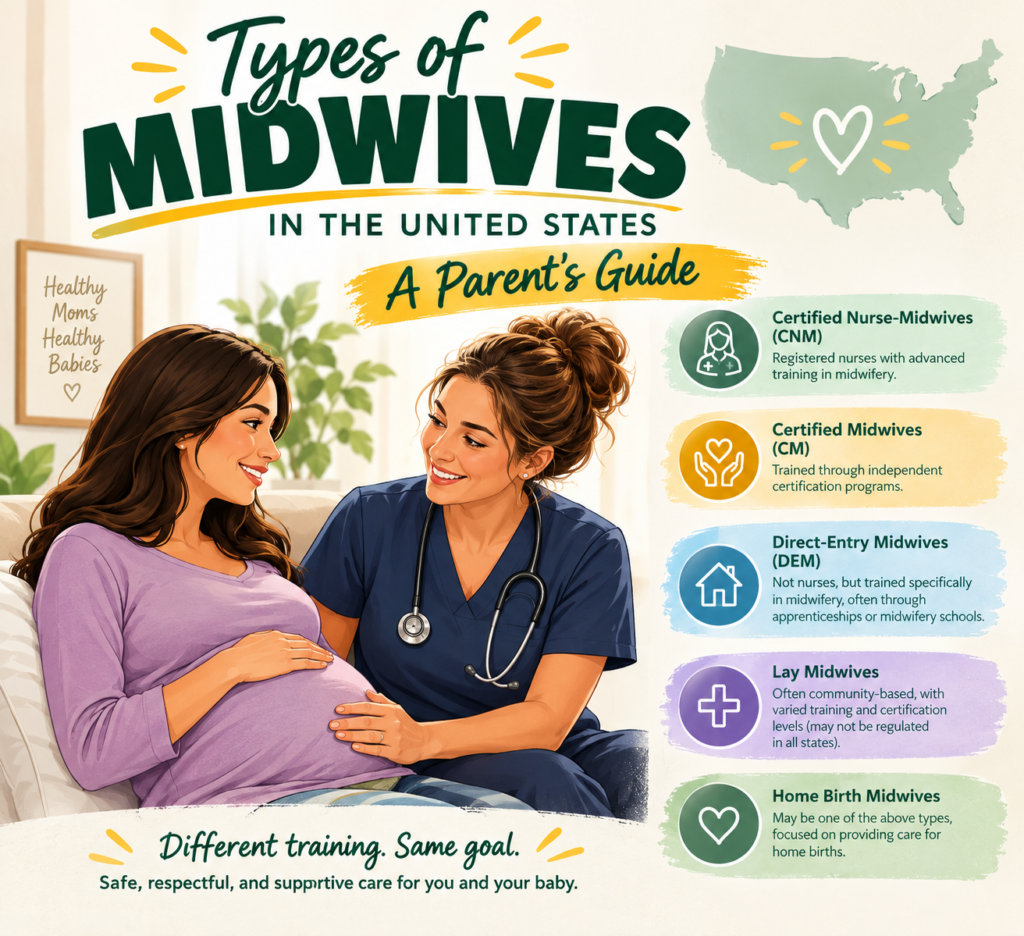
There are three broad categories of midwife in the US today, certified nurse midwives and certified midwives, licensed or certified direct entry midwives, and lay or empirical midwives.
Certified Nurse Midwives and Certified Midwives
Certified Nurse Midwives, CNMs, and Certified Midwives, CMs, are both credentialed through the American College of Nurse Midwives and hold the same certification exam and scope of practice. The difference is background, a CNM comes to midwifery through nursing first, while a CM enters through a non-nursing graduate route. Both credentials require a graduate degree from a program accredited by the Accreditation Commission for Midwifery Education, ACME. That’s a real shift from years ago, when a one year certificate program or a bachelor’s degree was enough to get started. Since 2010, every accredited program has had to award a master’s degree, a Doctor of Nursing Practice, or a Doctor of Midwifery at minimum.
The CM credential specifically is recognized in thirteen states plus DC right now, Arkansas, Colorado, Delaware, Hawaii, Maine, Maryland, Minnesota, New Jersey, New York, Oklahoma, Rhode Island, Virginia, and DC, with more states actively working toward licensing it.
Together, CNMs and CMs now number over 14,000 nationally, a huge jump from where the profession stood even twenty years ago. You’ll usually find them working in a collaborative relationship with physicians, though the exact setup depends heavily on the state. Right now, 31 states plus DC allow CNMs to practice fully independently, 2 states still require physician supervision, and the remaining 17 require some form of collaborative agreement for at least part of their scope, often tied to hospital deliveries or prescribing. Prescriptive authority itself, including for controlled substances, is well established nationwide at this point, that’s no longer the open question it once was.
You can find current program listings and general information through the American College of Nurse Midwives, and their journal, Journal of Midwifery and Women’s Health, is a good way to stay current on issues facing the field.
Licensed or Certified Direct Entry Midwives
Direct entry midwives typically practice in home or birth center settings, and they get there through a mix of formal schooling, apprenticeship, and self study rather than a nursing background. That doesn’t mean nurses can’t take this path too, plenty do. What sets a licensed or certified direct entry midwife apart is that they’ve had to prove they meet a defined set of skills and knowledge requirements through both exams and documented experience.
The credential most direct entry midwives hold today is Certified Professional Midwife, CPM, issued by the North American Registry of Midwives, NARM, which has been certifying midwives since 1991. This is where things have changed the most in recent decades. CPM licensure or legal recognition now exists in 37 states plus DC, which covers most of the country. As of the most recent count, there are roughly 2,600 actively certified CPMs, accounting for something like one in five midwives practicing in the US. Licensed midwives typically work with state health departments, can sign birth certificates, and increasingly get reimbursed by insurance for home and birth center deliveries.
The Midwifery Education Accreditation Council, MEAC, accredits the direct entry education programs that feed into CPM certification, separate from the ACME accreditation that governs CNM and CM programs. The Midwives Alliance of North America, MANA, sets the core competencies CPMs are trained and tested against.
Lay or Empirical Midwives
This category covers midwives who practice without formal licensure or certification, for a range of reasons. Some work in states where certification isn’t required unless they want to bill state or federal insurance programs. Some haven’t pursued licensure yet. Others are part of a specific religious or cultural community and intentionally practice outside the formal system. This group also isn’t exclusively non nurses, some are experienced, well trained practitioners who simply haven’t sought a credential.
Community based midwives, licensed and unlicensed both, have been serving families across North America for generations. The care and outcomes you get will vary a fair amount depending on which type of provider you choose, which is exactly why it’s worth understanding these distinctions before you pick one.
What Can Midwives Do
This depends entirely on licensure type and the laws in your specific state. CNMs can generally obtain hospital privileges, prescribe medication, and attend births at home, in the hospital, or at a birth center. Beyond pregnancy and birth, most also provide family planning and general women’s health care. Some work in busy hospital settings with more of a shift based schedule, others run solo or group private practices, and some split time between clinical midwifery and public health work through agencies like Planned Parenthood or local health departments.
Hospital privileges matter more than they might sound like they do, since they determine whether a midwife can independently order labs, imaging, and use hospital resources directly rather than routing everything through a physician. This varies by hospital, based on that facility’s own bylaws, but CNMs have made significant, steady progress here over the past few decades as more hospitals recognize the demand from patients who specifically want midwifery care.
Midwives without hospital privileges, which includes most direct entry and lay midwives, generally need to work through a collaborating physician if a client needs to transfer into a hospital or access services like an ultrasound. Many maintain a relationship with a supportive physician for exactly this reason, or rely on a hospital’s on call provider if a transfer becomes necessary. Attitudes toward these transfers have improved substantially as out of hospital birth has become more common and more accepted.
What Do Midwives Do
At the core, midwives provide prenatal care, support you through labor and birth, and manage the postpartum period for both you and your newborn. Most also provide general women’s health services, family planning, and preventive care like pap smears. A lot of the actual value midwives bring is less about procedures and more about time, patience, and continuity, sitting with you through questions and concerns rather than rushing through an appointment.
What any individual midwife is legally able to do comes down to her specific training, her credential, and her state’s regulations. CNMs in most states can prescribe medication broadly and often provide care through menopause, not just during childbearing years. All midwives, regardless of credential, are trained to recognize when something falls outside the range of normal and to refer out or bring in additional support when needed. That’s really the throughline across every type of midwife, deep expertise in what a normal, healthy pregnancy and birth look like, and the judgment to know when something isn’t following that pattern.
How Do I Become a Midwife
The right path depends on where you live, your current education, and honestly, your own reasons for wanting to do this work. Getting clear on both your short term and long term motivations first will shape which route actually makes sense for you.
A lot of midwives get their start in childbirth education or doula work, spending time around births and other midwives before committing to a formal training path. From there, the route splits based on background, nurses typically pursue a CNM or CM program, while those coming from outside nursing look at direct entry programs accredited through MEAC. Either way, it’s worth spending real time with a program’s accreditation and requirements before committing, since ACME accredits CNM and CM programs, and MEAC accredits direct entry ones. Both organizations can point you to current, accredited options in your area.
Where Do I Find a Midwife
Start by asking around locally, childbirth educators, other parents, and local doulas often know exactly who in your area is worth talking to. Our own guide to finding and working with a doula is a good companion read here, since doulas and midwives frequently work alongside each other and doulas tend to know the local midwifery landscape well.
Local hospitals, health departments, and birth centers can usually point you toward midwives who practice in your area, and La Leche League leaders and other parent focused groups are often a great source of firsthand recommendations. Availability varies a lot by region, in some areas you’ll find midwives easily, in others it takes more digging, so it’s worth casting a wide net.
You can also search directly through the American College of Nurse Midwives for CNMs and CMs in your area, or through the Midwives Alliance of North America for direct entry and CPM midwives.
Sources: