By KidsDirect Editorial Team
The Freshman Year Survival Guide for Parents
Freshman year hits different than parents expect. You brace for the obvious stuff, the bigger building, the older kids, maybe a rougher class or two. What catches most families off guard is how much freshman year actually matters, quietly, in the background, while everyone’s still adjusting to locker combinations and lunch schedules.
Here’s what the research actually shows. Researchers at the University of Chicago Consortium on School Research have spent years tracking what predicts whether a student graduates on time, and ninth grade performance turns out to be the single strongest signal, stronger than eighth grade test scores, stronger than family income, stronger than almost anything else you’d guess. They call it being Freshman On Track, and it comes down to something simple, whether a student passes their core classes and racks up enough credits in that first year. Kids who do are dramatically more likely to graduate. Kids who fall behind freshman year often never fully catch back up, even if they’re plenty capable.
That’s not meant to scare you. It’s meant to explain why this particular year deserves more attention than “how was school” at dinner. For more on this stage of parenting, our full collection of articles for teens covers what comes after freshman year too. Here’s what’s actually going on for your freshman, and where you can actually help.
Why Freshman Year Is a Bigger Deal Than It Looks
One study looking at a district of 8,000 students found a 33 percent ninth grade course failure rate, even with support programs already in place. That’s not a district full of struggling kids either. Researchers specifically studied students who’d been average or above average performers in middle school and still failed core classes their first year of high school. The good news buried in that same research, most of those kids turned it around. Eighty percent of the ones who failed a class passed it back in summer school and got right back on track for graduation.
So the failure itself usually isn’t the real problem. The real problem is how long it takes anyone to notice. In that same study, more than half the struggling students didn’t get any kind of academic intervention until their second year of high school, after they’d already failed freshman classes. Schools were waiting for a clear pattern of failure before stepping in, instead of catching kids while they were still just starting to slip. As a parent, you don’t have to wait for that pattern either. You’re allowed to check in well before report cards make the problem obvious.
The Academic Reset
Middle school and high school grading often don’t work the same way, and a lot of freshmen get caught off guard by that. Assignments count for more. Teachers expect more independent problem solving and less reminding. A kid who coasted through middle school on natural ability sometimes hits ninth grade and realizes coasting doesn’t work anymore, and that adjustment alone can tank a GPA in the first few weeks before anyone even flags it as a concern.
One thing worth knowing, extracurricular involvement turned out to be one of the strongest protective factors in that same research. Nearly three quarters of the students who eventually recovered from a rough start credited sports or activities with keeping them engaged and connected to school. Interestingly, some of those same students saw their grades dip again once their season ended, which tells you something useful, it’s not really about the sport itself, it’s about having a reason to stay plugged in and a coach or group of peers who’d notice if something felt off.
So if your freshman is hesitant about joining anything, that’s worth pushing back on a little, even something low stakes. It’s not just a resume line, it’s a built in check-in system that isn’t you.
Beyond that, keep half an eye on the basics without hovering over every assignment. Is homework actually getting turned in, not just done. Are grades trending in one direction over a few weeks rather than staying steady. Our tips on homework habits are a good place to start if this is already feeling shaky.
The Social Reset
Here’s something that surprises a lot of parents, freshman year friendships often look nothing like eighth grade friendships did, and that’s normal, not a red flag. High schools usually pull kids in from multiple middle schools, so your freshman’s entire social map gets scrambled at once. Kids who were inseparable in eighth grade sometimes drift, not because anything went wrong, but because they land in different classes, different lunch periods, different activities, and just don’t cross paths as often.
Give this more time than feels comfortable before you worry. Most freshmen take a solid chunk of that first semester to figure out where they actually fit, and some genuinely don’t land anywhere solid until sophomore year. That’s uncomfortable to watch as a parent, but it’s not the same thing as a real problem.
What is worth paying closer attention to is the difference between a slow social transition and an actual shift toward a crowd that worries you, secrecy that feels new, dropped activities they used to care about, or a personality change that feels bigger than typical teenage moodiness.
Screen Time and Freedom, Where to Start
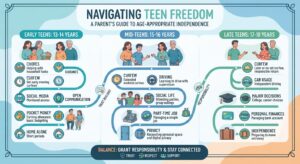
Freshman year is usually when phone use, social media, and requests for more independence all ramp up at once, right as academics get harder too. That’s a lot hitting at the same time, which is part of why this year feels so intense for families.
You don’t need a fully worked out four year plan by September. What actually helps is starting with something specific and adjustable, a general curfew, a rule about phones at night, an understanding about where they can go without checking in first. Treat freshman year rules as a starting point you’ll revisit, not a rulebook carved in stone. If you want a fuller breakdown of where to draw these lines and how to loosen them as trust builds, that’s exactly what we cover in our guide on how much freedom a high school teen should have.
Talking to Your Freshman Without Turning Into a Lecture
Fourteen and fifteen year olds tend to shut conversations down fast if they sense a lecture coming, and freshman year gives you plenty of openings that can accidentally turn into one, grades, friends, phones, all of it. The short version, ask more, tell less, and pick your moments outside of the actual moment something went wrong, car rides and casual downtime tend to work better than a sit down conversation right after a bad grade shows up.
If this feels like a bigger sticking point in your house than it should, we’ve got a full guide on how to talk to your teen without starting an argument that goes deeper into what actually works.
Warning Signs Worth Actually Watching For
Most of freshman year’s bumps are completely normal and smooth out on their own. A few things are worth taking seriously if you notice them stacking up together rather than showing up alone. A grade drop that doesn’t recover after a few weeks. Withdrawing from activities or friends they used to care about. New secrecy that feels different from normal teenage privacy. A mood shift that sticks around rather than coming and going.
None of these on their own means something’s wrong. Together, over a stretch of weeks, they’re worth a direct, calm conversation rather than waiting to see if it passes. Our piece on how to know if your teen is hanging out with the wrong crowd walks through this in more detail if you’re seeing a few of these at once.
Setting Up a Better Sophomore Year
The single most useful thing you can do this year isn’t fixing every rough patch. It’s staying close enough to actually notice one forming. Freshman year sets the tone for the rest of high school, not because one bad semester ruins everything, but because it’s the year most families either build a habit of checking in early or fall into the habit of waiting for report cards to tell them something’s wrong.
Check in on grades before they’re a crisis. Push gently toward one activity even if they’re resistant. Give the social stuff more runway than feels comfortable. And keep the conversation open enough that if something really is wrong, you’re one of the first people who hears about it, not the last.
Sources: