By KidsDirect Editorial Team
A Parent’s Guide to Age Appropriate Independence
How Much Freedom Should a Teen Have?
Every parent of a teenager eventually lands on some version of the same question. Is this too much freedom, or not enough. Your freshman wants to walk to a friend’s house alone. Your junior wants the car keys on a Friday night. Your senior wants you to stop asking where they are at all. There’s no chart that tells you exactly when to say yes, but there’s a surprising amount of research on what actually helps teenagers grow into capable adults, and it points in a pretty clear direction. It’s not about handing over the keys to everything at once, and it’s not about holding on tight either. It’s about something in the middle that most parents get right more often than they think.
Why This Question Doesn’t Have One Right Answer
Most teenagers are different, and so is every family’s comfort level, neighborhood, and set of worries. A fourteen year old who’s dealt with real responsibility since childhood might be ready for more rope than a sixteen year old who’s never had to manage their own time. That’s normal. The goal isn’t to match some universal timeline. It’s to keep expanding your teen’s independence at a pace that matches their judgment, while staying involved enough that you’d know if something went wrong.
What trips parents up is treating freedom like an all or nothing switch. Either your teen has full access to everything, or you’re tracking their location and reading their texts. Almost nobody actually needs to live at either extreme, and research on adolescent development suggests the middle ground is where teens do best, not just behaviorally but in how they feel about themselves and their own future.
What the Research Actually Says About Control and Rebellion
A large body of research on teen development keeps landing on the same finding. A strong sense of control over your own life predicts better outcomes across the board for adolescents, including better physical health, lower rates of substance use, less chronic stress, stronger motivation, and better academic performance, according to a research summary from UC Berkeley’s Greater Good Science Center. Teenagers who feel like they have some real say in their own lives tend to do better, not worse.
The flip side matters just as much. When parents get too controlling, teens usually respond one of two ways. Some push back openly, arguing or breaking rules outright. Others go along with everything on the surface but quietly resist, sneaking around rules just to feel like they have some say in their own life. Neuropsychologist William Stixrud and teen coach Ned Johnson, authors of The Self-Driven Child, argue that handing teens real decision making authority, within reason, is what actually builds the kind of self motivation parents are hoping for. Author Mike Riera has put it more bluntly, warning that parents who stay too controlling for too long often get quietly fired as their teenager’s manager, meaning the teen just stops listening and starts making decisions without them entirely.
None of this means dropping every rule. It means the rules that stick are the ones your teen had some part in shaping, and the freedom that works is the kind that comes with real boundaries attached.
The Middle Ground That Actually Works
Decades of parenting research keep pointing to the same style as the sweet spot for teenagers, usually called authoritative parenting. It means setting clear limits while staying warm, involved, and willing to explain your reasoning rather than just issuing orders. It’s different from being permissive, where there aren’t really any limits, and different from being authoritarian, where the limits exist but there’s no room to discuss them.
In practice, this looks like two things happening together. First, you and your teen talk through the family’s actual rules around the big stuff, driving, curfew, phones, alcohol, rather than you just announcing them. Second, inside those boundaries, your teen gets real room to make their own calls and live with what happens, good or bad. If they want your opinion on something, you can give it honestly, but the follow up matters just as much. Something like “here’s my concern, but it’s your call” respects that they’re the one who has to live with the outcome, and it teaches them to actually think a decision through instead of just doing what they’re told or rebelling against it.
This is also where a lot of the friction in parenting a teenager quietly resolves itself. Most of the arguments that feel like they’re about a curfew or a phone are actually about whether your teen feels like they have any say in their own life.
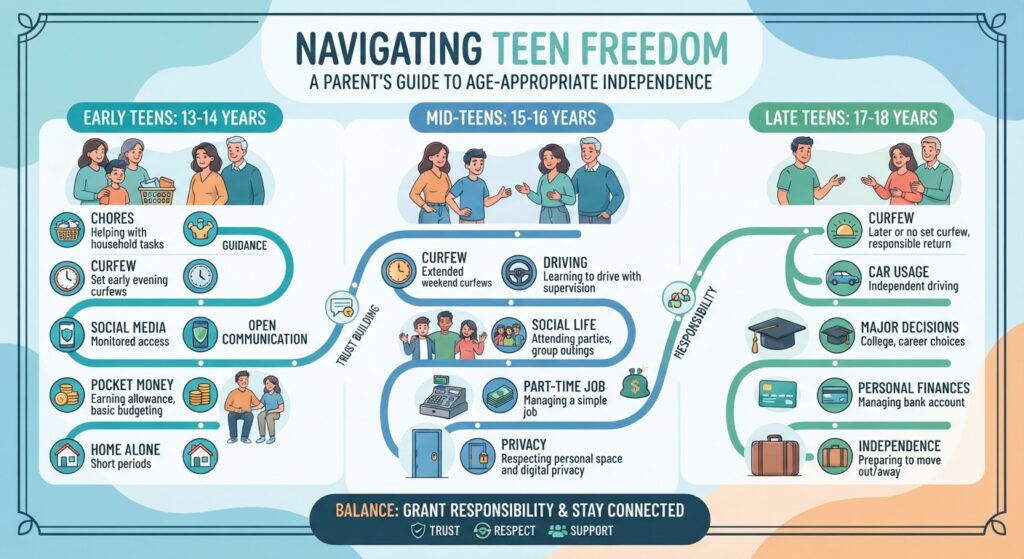
A Realistic Freedom Ladder, Grade by Grade
These are general starting points, not rules carved in stone. Adjust based on your own teen’s maturity and your family’s situation.
Freshman year. This is usually the first real stretch of independence, walking or biking places alone, staying home without an adult for a few hours, having some unsupervised time with friends. It’s also, as we covered in our guide to surviving freshman year, a year where academic habits and social footing both get established, so freedom usually needs to be paired with check ins rather than handed over and forgotten.
Sophomore year. More social independence, later curfews on weekends, a phone with fewer restrictions, maybe a part time job or more say over their own schedule. Many states also allow a learner’s permit around this age, which opens up an entirely new category of trust to build.
Junior year. This is often when driving privileges become real, along with more autonomy over homework and time management since junior year academics tend to carry more weight for college admissions. It’s also a good year to start stepping back from managing their workload directly, something we cover in our homework tips for teens.
Senior year. The closest thing to a dry run for the independence they’ll have after high school. Later curfews, more financial responsibility, more say over their own choices about college, work, or whatever comes next. If they’re headed to college, this is genuinely the last year you have this much influence in daily decisions, so it’s worth using it to build habits rather than tighten control.
The Areas Parents Worry About Most
Driving. Most states use graduated licensing for a reason, limiting nighttime driving and passengers at first. Even once your teen has a full license, it’s reasonable to keep some house rules around driving conditions, distance, or who’s in the car, especially in the first year.
Curfew. A moving target that should loosen as trust builds. What matters more than the exact time is whether your teen tells you where they are and follows through on what they said they’d do. A missed check in is a bigger red flag than a curfew that’s fifteen minutes late.
Phones and social media. This is the area where most families land somewhere between full monitoring and total hands off, and there’s no single right answer. What tends to work is being upfront about what you’re checking and why, rather than covert monitoring, since teens who find out they’ve been secretly tracked often respond with the same quiet resistance described above.
Unsupervised time. Whether that’s an empty house after school or a weekend with friends, the honest question to ask is what your teen has actually shown you about their judgment so far, not what other parents are allowing. Comparing your teen to their friends’ freedom is one of the fastest ways to make a decision that doesn’t fit your own kid.
Money. Whether it’s an allowance, a part time job, or their first debit card, money is one of the clearest ways teens practice real independence with real consequences attached. A teen who’s managing their own spending money, even a small amount, is getting practice at budgeting and delayed gratification that’s a lot harder to teach through a lecture than through actually running out of money once and figuring out why.
When Your Teen Pushes Back Anyway
Even with a fair, collaborative approach, plenty of teens will still push for more than feels comfortable. That’s developmentally normal, not a sign you’re doing something wrong. A few things help when that happens. Separate the request from the tone. A poorly delivered ask (“give me the car or I’ll never talk to you again”) doesn’t mean the underlying request was unreasonable. Give a real reason when you say no, even if it’s just “I need to see this go well a few more times first,” rather than a flat no with no explanation. And where you can, offer a path. “Not yet, but here’s what would need to change” gives your teen something to work toward instead of just a closed door.
It also helps to remember that pushing back is usually about the underlying need for control, not the specific thing they’re asking for. A teen who’s genuinely upset about a curfew is often really reacting to feeling like nothing in their life is up to them lately. If that’s the pattern, the fix usually isn’t relaxing the curfew, it’s finding some other area where you can hand over more real say, even something small, so the pushback has somewhere else to go.
Some of the bigger, harder conversations, about drugs, relationships, or serious risk taking, deserve more than a quick house rule. If you’re navigating one of those, it’s worth reading more broadly on how families get through the harder moments of the teen years rather than treating it purely as a freedom question.
Making It a Conversation, Not a Verdict
The families who navigate this well tend to treat freedom as something that’s discussed and earned together, not announced from above. That might mean sitting down at the start of a school year and talking through what’s changing and why. It might mean letting your teen make the case for more independence in a specific area, and actually listening before you answer. The version of this that works isn’t about finding the exact right amount of freedom on the first try. It’s about staying in the conversation long enough to adjust when you get it wrong in either direction, and most parents will get it wrong in both directions at some point. That’s not failure. That’s just what raising a teenager actually looks like.