By KidsDirect Editorial Team
Why closeness matters in the early months
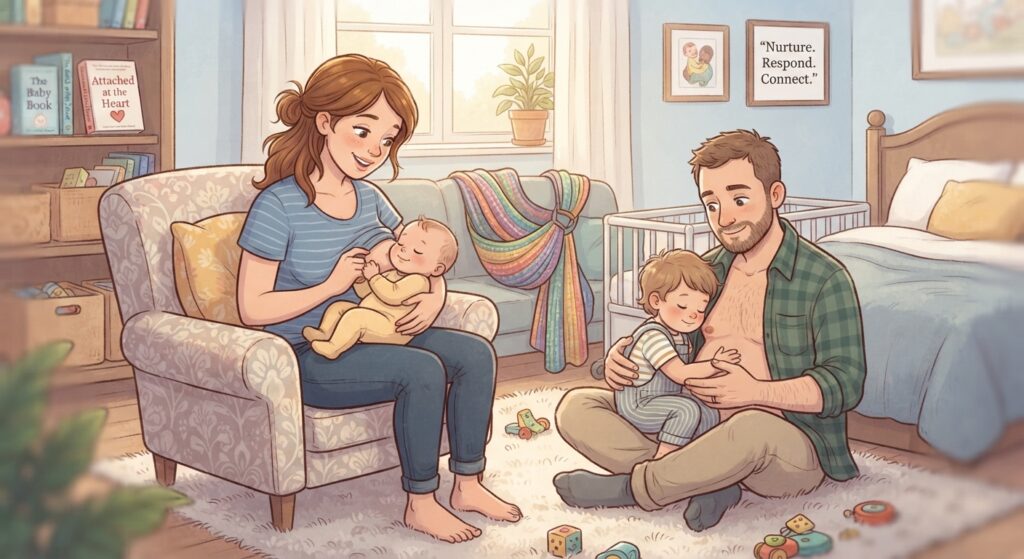
Attachment parenting has been around for decades, and it’s stuck around for good reason. When you respond quickly to your baby’s cries, hold them often, and keep them physically close, you’re building the kind of trust that shapes how they handle stress and relationships for years down the road. Parents who practice this style often notice their babies seem calmer and more securely attached, and there’s real research backing up that feeling, not just parental instinct.
The case for sleeping close to your baby
Breastfeeding at night comes a lot easier when your baby sleeps within arm’s reach, and plenty of moms find their milk supply stays stronger because of those extra nighttime feeds. Babies who sleep close to a parent tend to settle faster when they stir, since comfort is right there instead of down the hall. That quicker response often means less crying overall, which tends to mean better sleep for the whole family, not just the baby. If you’re still working out what the rest of that first year looks like, our guide to your baby’s first year walks through what to expect month by month.
What the research on cosleeping actually shows
Current guidance from the American Academy of Pediatrics recommends room sharing without bed sharing for at least the first six months, and we want to be upfront that this guidance exists. At the same time, we’ve raised four kids of our own with a good amount of bed sharing mixed in, and we’ve come to feel differently about it than the official recommendation, based on both our own experience and a body of research that doesn’t get as much attention. For the full list of safe sleep steps, see our guide to SIDS and safe sleep.
Dr. James McKenna, who ran the Mother Baby Behavioral Sleep Laboratory at the University of Notre Dame, spent decades studying cosleeping families up close. His research found that infants who bed share under safe conditions tend to breastfeed more often at night, arouse from sleep in healthy patterns, and have parents who respond to them faster. Bed sharing is also the cultural norm across much of the world, and countries where it’s common don’t consistently show higher SIDS rates than countries where it’s discouraged. None of this cancels out the AAP’s concerns, but it does mean the picture is more nuanced than “never do this,” and families deserve to know that when they’re making their own decision.
If your family chooses to share a bed
Whatever you decide, the way you set up the sleep space matters more than the decision itself. Researchers who study safe cosleeping, including McKenna, point to a consistent set of conditions that lower the risk significantly.
- Baby sleeps on their back, on a firm, flat surface with no soft bedding, pillows, or thick blankets nearby
- No couches, sofas, recliners, or waterbeds, since these surfaces are genuinely dangerous for bed sharing
- No smoking in the home, and no alcohol, sedatives, or other substances that would make a parent hard to rouse
- Both parents are on board and know the baby is there, since accidental co sleeping without that awareness carries more risk
- Long hair is tied back, and the baby isn’t sleeping between two adults, only next to one
When bed sharing isn’t the right call
Some situations call for room sharing in a separate bassinet or crib instead, even for families who otherwise feel good about cosleeping. Formula fed babies, babies under a year old sharing a bed with older siblings, premature or low birth weight infants, and any household where a caregiver smokes or uses substances that affect alertness all fall into this category. If any of these apply to your family, room sharing without bed sharing gives you most of the closeness with less risk. Our page on sleeping with your baby explains the riskiest situations in more detail.
Trust your instincts, and stay informed
There’s no single right answer here, and you don’t need to feel judged whichever way you land. What matters most is that you go in with real information rather than guesswork, that you set up whatever sleep arrangement you choose as safely as possible, and that you keep checking in with your pediatrician as your baby grows. Attachment parenting isn’t about following one rule to the letter, it’s about staying tuned in to your child and making thoughtful choices for your own family. You can find more newborn care guidance on our BabiesDirect hub.