By Dr. Kalman Heller, Child and Family Psychologist
A Tragedy That Leaves Us Searching for Answers
Once again, I’m writing in the wake of a terrible tragedy. Fifteen dead children. Fifteen lives ended prematurely and violently. An entire community that won’t recover for generations. An entire nation searching for answers that don’t fully exist. Acts of violence have always been part of human nature, and that won’t change unless we become some kind of science fiction world of engineered chemistry and genetics. Experts will point to the usual list of contributing factors, alienation, access to guns, too much exposure to violence, leaders who model poor values, families disconnected from any real community. But the reality is that the vast majority of teenagers grow up inside that exact same environment and never hurt anyone. I’d have to ask, what protects teens from serious trouble? That doesn’t mean we should stop working to reduce the negative influences in their lives, and in ours. It does mean that no matter what we do, tragedies will keep happening. We simply don’t have as much control over another person’s life as we’d like to believe. That’s a frightening thing for most parents to accept.
What Actually Predicts Serious Trouble
None of this means parents shouldn’t be doing things that make it more likely their child turns out okay. Inside plenty of homes right now, a parent is quietly wondering whether their son or daughter could be in real trouble without them knowing it. Or, even scarier, a parent can see their child struggling and feels genuinely powerless to help. What do we actually know that helps? The research points to the same answer almost every time. Kids with stronger relationships with their parents are less likely to end up in SERIOUS trouble. I’m emphasizing “serious” because parents get worked up far too often over things that aren’t life-threatening or life-defining. A messy room, grades and homework, disorganization, impulsive mistakes, foul language, an extra piercing, some grungy-looking friends, a broken curfew, or the small protective or manipulative “lies” kids tell to get away with things, these are all normal adolescent behavior, and none of them alone means a child is “going down the tubes.”
Why Adolescence Feels So Destabilizing
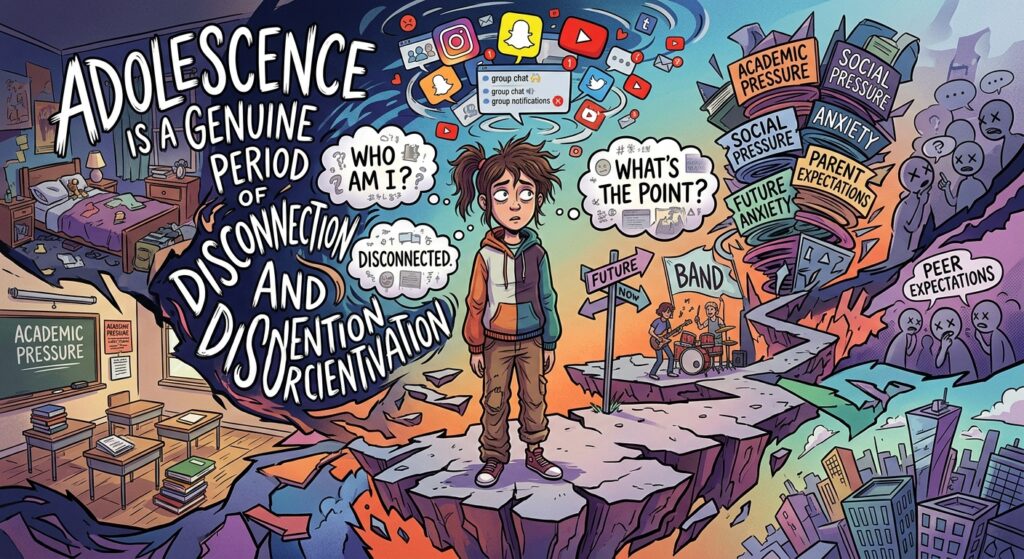
For a lot of teens, adolescence is a genuine period of disconnection and disorientation, of becoming unsure about their own values or their capacity to succeed. It’s a time of real fear about a changing body and shifting friendships, and of experiencing failure in places where success used to come easily. It’s a time to question and distrust authority almost on principle. And especially with how much the online world has expanded a teenager’s exposure to everything, it’s a genuine challenge for them to process and manage all of it at once.
Focus on Connection, Not Control
Parents often respond to all this by fighting for control. It’s essential to hold firm on a few non-negotiable rules around health and safety, and to bring in outside help at any real sign of serious trouble, like depression, explosive outbursts, disordered eating, substance use, or a marked shift in personality. But beyond those non-negotiables, it matters far more to focus on process than on content. What does that actually mean? Simply that nothing substitutes for keeping the connection between you and your teenager alive. Make time for real one-on-one interaction. Be ready to give your full attention the moment your teenager is suddenly willing to talk. Spend some time genuinely inside your teenager’s world without rushing to judge what you find there. Run errands together. Find some activity you can actually share. Take your teen out to dinner now and then. If your work involves travel, bring a teenage child along occasionally and turn it into real, valuable time together. Get to know each other.
Be Honest About Your Own Mistakes
Remember that you almost certainly got some things wrong along the way yourself. It can genuinely help to admit that out loud. Why would your child be open with you if there’s no reciprocity in the relationship? That includes being honest about your own current worries or mistakes. We all mess up. We all carry our own vulnerabilities. We’re all just looking for some safety and security. In that sense, you and your teenager have more in common than it might feel like. The real difference is that a teenager’s life comes with very few genuine choices and holds very little valued place in our society. We ask them to be responsible, but there’s rarely any immediate payoff for that beyond keeping the adults around them from being angry or disappointed. Believe in your child, even when they’re struggling, even when they’re falling short of what you hoped for.
When Nothing Seems to Help
For some parents, there’s the harder reality that, despite doing everything right, their child is genuinely struggling, and the parents feel shut out while nothing they try seems to help. That’s painful and frightening, full stop. Even with professional support and help from school staff, some kids still end up in a genuinely dark place, shaped by biology, peer influence, and larger social forces beyond any one family’s control. It’s worth naming honestly that mass violence like this has overwhelmingly involved male perpetrators. Our culture sends powerful messages that kids absorb differently depending on their gender, and those messages often land very differently, sometimes turning inward as anxiety or disordered eating, sometimes turning outward as aggression toward others. In the face of all this, it makes sense that parents feel more worried than ever about their children’s health and safety. If you’re genuinely concerned about a teenager’s mental health, SAMHSA’s National Helpline is a good place to start.
Be the “Charismatic Adult” in Your Child’s Life
But I need to come back to my real message here, which is urging parents toward a more optimistic outlook, and asking them not to let their own anxiety undercut the thing that matters most, the relationship between each parent and each child. My friend and colleague Dr. Robert Brooks has spent much of his career studying resilience in children and what actually builds it. The research consistently points to the presence of a “charismatic adult” as one of the strongest predictors of a child turning out okay. Read enough stories of successful adults who grew up in genuinely difficult circumstances, and there’s almost always a parent, relative, teacher, or coach mentioned who believed in them and stayed available when it mattered. Dr. Brooks often closes his talks by challenging parents to become that charismatic adult in their own child’s life. It’s no guarantee that everything turns out fine. Nothing can guarantee that. But it makes it a lot more likely you’ll end up with an adult child who’s not just doing well, but who’s also genuinely your friend.