A number of recent workshops with parents of toddlers, teaching toddler parenting tips, produced this list of ideas and key points to keep in mind when you’re parenting a child whose world is expanding fast, but whose verbal skills and grasp of time, place, and consequences are still pretty limited.
Use Visual Aids to Show Sequence and Time
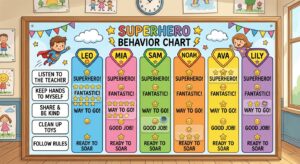
Visual aids are a huge help in building a sense of sequence and time around the routines that start and end the day. Charts with drawings or pictures paired with clock faces let a child grasp the specific steps needed to get through a process, while also starting to learn why sequence and timing matter for finishing complex tasks. It’s worth remembering how complicated getting ready to leave the house actually is for a 2 year old. There are so many steps to master and so-o-o many distractions along the way. And what’s “five minutes” to a toddler anyway? We talk about time constantly with very young children, and time is one of the most abstract concepts there is.
Warn Before You Ask for a Transition
Speaking of time, transitions are another major challenge for young children. At the end of one workshop, a mother went into the classroom to get her child and go home. The child resisted. The mother had been mentally preparing to leave. The child hadn’t. Kids need warnings, often more than one, to start winding down and finish what they’re doing. Toddlers will often need a parent to step into the activity to ease them out of it gently. Turning cleanup into a game or creating a clear ending helps, and so does gently shifting a child’s attention toward what comes next. It can help to talk through what will happen once you leave, especially if the child gets to actively decide something about the next stop, like which book she’d like you to read that night.
Turn Time Limits Into a Game
Timers give children something visual and concrete to focus on, and you can often turn the whole thing into a game. Can you brush your teeth or get dressed before the bell rings? One mother had success laying out a couple of outfit choices and racing the timer with a child who was struggling to get dressed in the morning.
Let Natural Consequences Do the Teaching
Parents also need to watch out for taking on too much responsibility for getting a child ready in the morning. Taking a child to preschool in pajamas with clothes packed in a bag can be a surprisingly powerful way to underscore that you can’t control your child’s behavior, but you can control the consequences. If you get pulled into believing it’s up to you to make sure everything is in perfect order before you leave, your toddler is training you, not the other way around.
Get Down to Their Eye Level
Whenever you’re trying to say something important to a young child, kneel down and say it softly, eye to eye. Parents often try to give directions or make requests from across the room instead of up close. But very young children can’t really focus their attention on a distant voice when it’s competing with whatever they’re touching or looking at right in front of them. Don’t call out from the next room and expect more than about two seconds of attention. Even standing near a child, words spoken from more than a few feet away, without eye contact or touch to anchor them, lose most of their effectiveness. It’s the same reason a teacher walking the room and simply touching an inattentive student’s shoulder can dramatically improve how well they’re heard.
Handling Biting
A biting 2 year old needs eye contact, a very firm “No”, immediate but quiet removal from the situation, and consistent repetition. Don’t waste time lecturing toddlers about it.
When a Toddler Is Rough With a New Sibling
A toddler being mean to a new baby calls for the same eye-to-eye “No”, but this time add a brief acknowledgment that it is hard to share your attention with a new baby, then pick up the baby and step away. That last part matters. It keeps the toddler from getting exactly what he was after, which is your focused attention, even if that attention comes in the form of being punished. For more on staying calm through moments like these, this piece on managing your own frustration as a parent has some useful strategies. And if you’re looking for discipline approaches that don’t involve spanking, firm, calm redirection like this is exactly the kind of alternative that works. This is great toddler parenting tips.
Use Distraction and Plan Ahead
Distraction is one of the most useful tools a parent has. It also helps to use what you already know about your child to anticipate trouble spots, like the toddler who always interrupts when you’re on the phone, or the slow-to-warm-up child who runs out of patience in a group activity. Keep an interesting object on hand that will hold your child’s attention for a few minutes (something not otherwise available for play) or a favorite book to read together until she’s ready to enter or re-enter the situation. One mother, whose son was hitting other kids during group play, realized he’d give her a clue by coming over and clinging to her whenever the social intensity got to be too much. This is a good example of toddler parenting tips Once they worked out that signal, she could call him over for some quiet time before things escalated into an incident.
Recognize Sensory Sensitivities
Some toddlers have genuinely hypersensitive sensory systems. They react with distress to loud noises, can’t tolerate physical closeness (they don’t relax when you hold them, and they lash out when another child gets suddenly in their face), or reject foods and clothing that don’t “feel right” in their mouths or against their skin. These are real issues, not defiance. Sensory processing differences are worth treating as such, with accommodations rather than worry that something’s permanently wrong.
Don’t Rush Toilet Training
Toilet training causes far more worry than it needs to. Gently encourage your child when she seems interested, and if she’s not ready yet, be patient. It’ll happen in due time. Setbacks are common too. Once a child masters it, don’t assume the issue is gone for good. For readiness signs and pacing, HealthyChildren.org’s toilet training guide is a good reference.
Helping “Hyper” Kids Fall Asleep
High-energy kids often struggle to calm their systems enough to fall asleep. They tend to need more gentle rocking, sucking, or rhythmic sound to drift off, and they’re less likely to fall back asleep on their own if they wake during the night. Short interventions are worth trying, but realistically, some kids will need your physical presence nearby to reset their own rhythm.
Let Them Be Toddlers
Keep in mind that toddlers aren’t in training to be miniature adults. Parents and teachers often put too much pressure on very young children to cope using words, when developmentally they’re still much better equipped to cope through action, touch, and what they can see. Let them be toddlers. Enjoy the process. It really does pass quickly.
By Dr. Kalman Heller, Child and Family Psychologist