By KidsDirect Editorial Team
Foods Babies Should Avoid
When your baby starts eating real food, you’ll get a lot of advice about what’s off limits. Some of it is solid, and some of it is decades old. The tricky part is that the rules fall into three different buckets. A few foods are choking hazards, a few aren’t safe until after the first birthday, and a few that used to be on the “never” list are now just fine. Here’s how to sort them out.
Choking Hazards
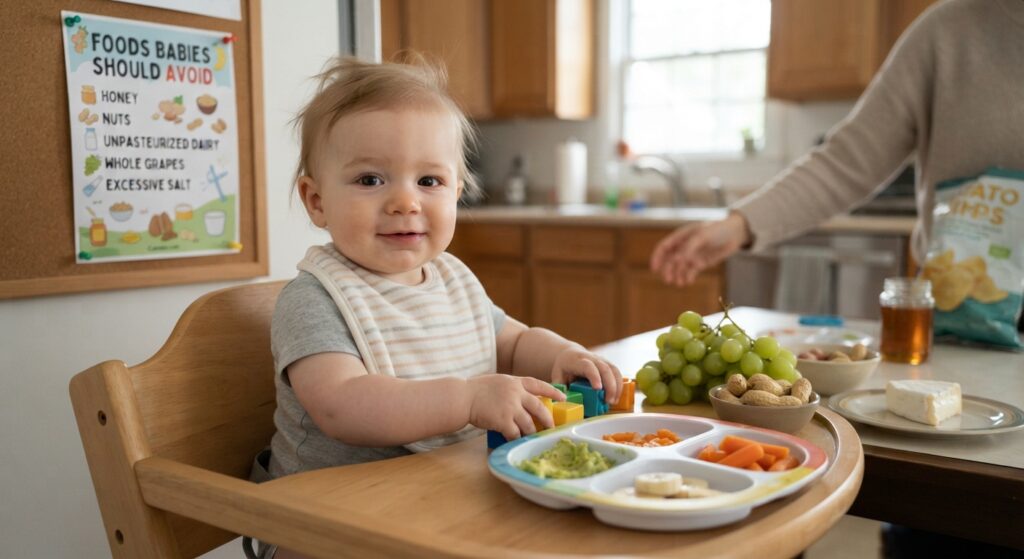
Some healthy, perfectly safe looking foods can block a small airway. A baby with only front teeth can bite off a chunk of raw carrot, but can’t actually chew it up. That’s how a snack turns into an emergency. The usual culprits are raw, hard vegetables such as carrot and celery sticks, whole grapes and cherries, raisins and other dried fruit, chunks of hot dog or other meat, and whole nuts. Popcorn, hard candy, and lollipops are on the list too. So are spoonfuls of peanut butter, since a sticky glob can lodge in the throat.
You may have heard that these are fine once your baby gets molars. Unfortunately it’s not that simple. Safety standards like Caring for Our Children treat foods like these as choking hazards for children under 4. Cutting food into pieces about a quarter of an inch or smaller for babies, and always supervising meals, helps a lot. If your baby is just getting started, our guide to feeding solid foods covers when and how to begin. Our guide to finger foods for babies shows how to prepare safe options.
Foods to Wait On Until After the First Birthday
The Centers for Disease Control and Prevention lists a few foods and drinks that really do need to wait. Honey tops the list. It can carry bacteria that cause infant botulism, so skip it, and anything baked or cooked with it, until after your baby turns one. Cow’s milk as a drink should wait too. It’s hard on a baby’s kidneys, though yogurt and cheese are fine earlier. Fruit and vegetable juice isn’t recommended for babies under 12 months either.
Also steer clear of added sugar and salty foods, such as processed meats and packaged snacks. Your baby’s taste for sweets and salt will arrive soon enough. That’s the reason chocolate still isn’t a great pick for a baby, even though it isn’t an allergy risk by itself. It’s mostly sugar, and it often has milk or traces of nuts in it. Finally, skip anything unpasteurized, including raw milk, soft cheeses made from raw milk, and unpasteurized juice.
Old Rules That No Longer Apply
Many older lists tell parents to avoid egg whites, peanut butter, nuts, seafood, beans, corn, and citrus fruit until the first birthday. Most of that advice has changed. Doctors now say that holding back common allergy foods doesn’t prevent allergies, and offering them early may lower the risk. Citrus is a good example. The acid can redden the skin around a baby’s mouth, which looks like a rash but is irritation, not an allergy. Corn and beans only rarely cause problems.
The key is how you serve them. Whole nuts are a choking hazard, but peanut butter thinned out or stirred into cereal or yogurt is a common first allergen. Beans can be mashed, and eggs and fish can be cooked and flaked. If your baby has severe eczema or an egg allergy, or allergies run in your family, talk to your pediatrician before you start. Our guide to foods that can cause allergic reactions in babies explains the nine foods behind most allergies and the signs of a reaction.
Worth knowing. Every baby is different, and your pediatrician knows yours best. For more on feeding and everyday baby care, browse our BabiesDirect section.