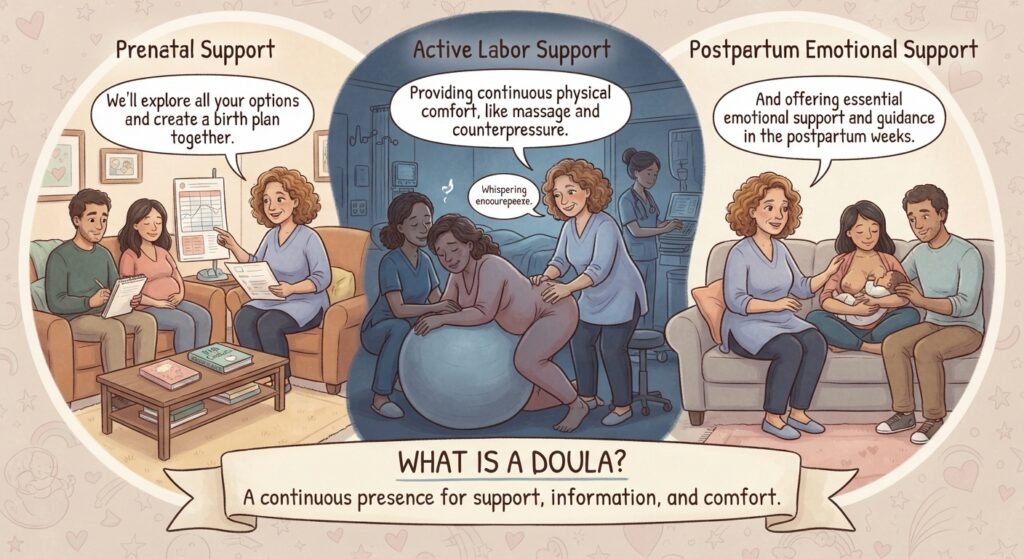
What is a Doula?
A doula is a woman experienced in childbirth who provides continuous physical, emotional, and informational support to a mother before, during, and after childbirth. She believes birth is a natural process, and she sees it as a transformational event in a woman’s life, one worth protecting and making as safe and positive as possible.
A good doula understands both the physiology of birth and the emotional needs of a woman in labor. She stays with the mother throughout labor, supports whatever birth choices the mother makes, and never pushes her own opinions onto the family she’s serving. She acts as an advocate for the mother and her partner, helps carry out their birth plan, and keeps communication flowing between the laboring woman, her partner, and the clinical team. She also helps the partner get involved at whatever level feels comfortable to him or her. A doula never replaces the partner’s role, she adds to it.
A few more ways to describe a doula
Doulas go by a few other names too, including childbirth assistants, labor support professionals, birth assistants, and birth companions. Whatever you call them, they provide emotional, physical, and informational support throughout pregnancy, labor, birth, and the early postpartum weeks.
A doula doesn’t replace the partner. Instead, she helps the partner show up fully, so he or she can love and encourage the laboring woman without feeling like they have to know everything or do everything alone. Women have leaned on other women for support during childbirth throughout human history. That’s a pretty basic human need, and it has nothing to do with how strong a woman’s relationship with her partner is.
How a doula works alongside dad
Some couples assume that if a partner plans to be fully involved in the birth, a doula isn’t necessary, as if doulas exist only for women without a partner in the room. Some dads even feel a little threatened at first, worried a doula might take over and crowd them out of their own baby’s birth.
In practice, a doula tends to make the experience better for both parents, not just the mother. During a prenatal visit, she’ll sit down with the couple to talk through the birth, and she makes a point of including the partner directly rather than routing everything through the mom. Dads get real space to voice their own concerns and questions, and the doula answers what she can while respecting how much or how little the couple wants to share.
Once labor starts, many doulas will come to the couple’s home to help them through early labor, then help pack the car and make calls when it’s time to head to the hospital. As labor picks up intensity, her role with the dad becomes even more useful. Because she’s seen labor play out many times before, she can reassure both parents when things are progressing normally, and explain what’s happening when they aren’t sure. That kind of steady, experienced presence tends to calm a father’s nerves, and a calmer dad tends to help the mother relax too, since she often takes her emotional cues from him.
The doula and dad frequently team up on hands on support, taking turns massaging the mother, helping her change positions to ease pain and keep labor moving, or walking the halls with her together. When it’s time to push, many mothers use positions that call for two people supporting her at once, and having both a partner and a doula there makes that far more manageable.
After delivery, the doula usually stays close to the mother while dad gets to soak in those first moments with the baby, make phone calls, or take a break, unless the family prefers otherwise. Most doulas also schedule a postpartum visit a day or two after birth to help with breastfeeding and newborn care, and to walk back through the birth story together, since it’s often hard to process everything in the moment.
What the research says about doula supported birth
This isn’t just a nice idea, there’s solid research behind it. A Cochrane review of continuous labor support, covering more than 15,000 women across 17 countries, found that women with continuous support were about 25 percent less likely to need a cesarean, had somewhat higher odds of an unassisted vaginal birth, used less pain medication, and reported far fewer negative feelings about their birth experience overall. Their babies were also less likely to have low Apgar scores at five minutes. It’s a strong enough pattern that the American College of Obstetricians and Gynecologists recommends continuous labor support as one of the most effective tools for keeping labor moving safely without unnecessary intervention.
If you’re thinking about hiring one, DONA International’s directory is a good place to find a certified doula near you, and asking your obstetrician or midwife for a referral is another solid starting point.