By Dr. Kalman Heller, Child and Family Psychologist
Time for a Better Vision
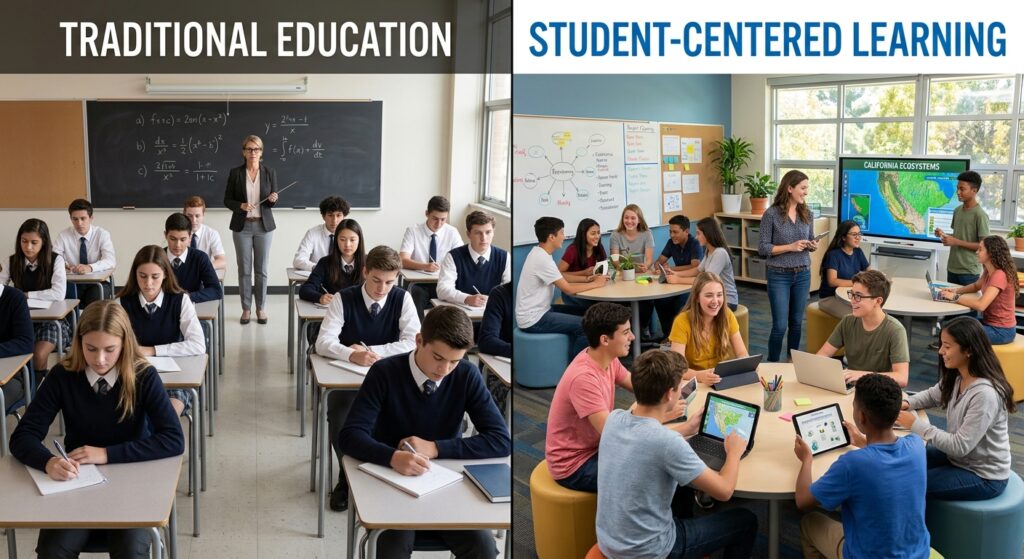
In my last article, I made the case that homework fails to prove its value as a way to improve learning or build character. That’s especially true at the elementary level, where there’s really no solid basis for assigning it at all. The research gets more mixed as kids get older, but even at the high school level, the evidence for homework’s value is genuinely shaky. Just as important, there’s growing evidence that homework can actually cause harm. It creates chronic stress for kids and families, and it ignores how different the homes are that children return to after school. Having made that case, I feel a responsibility to share what I’d actually build instead. Criticizing without offering an alternative isn’t fair. This really showcases student-centered learning vs traditional education.
We Keep Fixing the Wrong Things
Have you noticed that when politicians and school administrators talk about improving education, which has really become a euphemism for raising standardized test scores, the focus almost always lands on systemic changes? Longer school days or years, better trained teachers, improved facilities, more drilling (“back to basics,” whatever that actually means), vouchers or school choice, statewide testing, these are the usual “cures” offered up for public education. Poverty, the breakdown of character and morality, lack of parental involvement, and the influence of screens also make the list of what ails our schools. Some of these, poverty especially, are genuinely and strongly linked to academic struggles. But what always strikes me as missing is any real conversation about how children actually learn, and what it would take to build an environment that gives every child a real shot at a good education.
Our Classrooms Haven’t Caught Up With the Research
Educators and psychologists have built up a tremendous amount of valuable research and theory over the past several decades. Very little of it has made its way into how public schools actually run. Today’s classrooms look strikingly similar to classrooms from a hundred years ago, a group of kids with a wide range of ability sitting in chairs, listening to a teacher, in what amounts to a passive learning experience that ignores most of what we now know about child development. Kids of every age are naturally egocentric in how they engage the world. They’re drawn to what feels immediate to their own experience, and they learn best through hands-on, interactive experiences. Honestly, most adults learn best that way too. At the elementary level, play is a genuine tool for learning, and so is imitation. Sitting still for long stretches runs against how young children actually develop, and constantly restricting social interaction isn’t just developmentally inappropriate, it slows the growth of the social and relationship skills that matter most for a successful life. Recent research on student-centered learning backs this up, showing real gains when classrooms move away from this traditional model.
Teachers Need More Room to Teach
Our classrooms remain too teacher-centered. And yet I’d also argue they aren’t adequately teacher-led. Teachers typically have their hands tied by an external curriculum and aren’t encouraged to get creative with it. Classes become cookie-cutter repeats instead of something unique, reshaped each year by the interaction between a creative teacher and a different group of kids, in a world that’s always full of new events and trends worth teaching from.
The Constant-Subject-Switching Problem
One of the more overlooked problems in education is the teaching of several unrelated subjects side by side. Kids are required to make constant jumps from one subject to the next, a multitasking challenge that would trip up plenty of adults. It gets worse as kids move up through the system. By seventh grade, most students are taking several separate courses a day inside a system that’s become genuinely impersonal, one where students and teachers rarely get the chance to build the kind of relationship that actually fosters learning. Most students can’t keep it all straight. Disorganization, forgetting, and a growing resistance to what feels like a punitive, disconnected process turn education into a kind of survival exercise. Only the kids whose personality happens to fit this particular system come out ahead. The rest slide into mediocrity or outright failure.
A Better Blueprint: Student-Centered Learning
My vision of a better approach centers on two things, student-centered learning and block scheduling. The first means teaching that works from the child outward, letting kids learn by engaging material that genuinely interests them, using group interaction and student-helping-student as a routine part of the classroom, and giving teachers real room to be creative. Kids would write about their own life experiences, read books that actually grab them, and learn math the way it shows up in the real world.
Teaching From the News, Not Just Textbooks
As kids get older, I’ve always believed daily news, whether in print, online, or however a family follows it, could replace a fair amount of textbook material. Something happens somewhere in the world every day that could anchor a lesson in history, social studies, science, reading, or writing. It would naturally pull in discussions of money, law, politics, and the social issues that actually matter. Most importantly, it would produce high school graduates who actually understand the world they’re living in, and who’ve practiced real thinking and problem solving along the way. Which is more likely to actually educate a teenager, reading a dry textbook chapter on ancient civilizations, or working to genuinely understand a complex crisis unfolding in the world right now?
Room for Every Kind of Strength
A student-centered approach like this would make learning feel relevant to a kid’s actual life, and it would produce a lot more young adults who actually want to keep learning. Those who are motivated toward it could go on to college, where they’d study the classics and take on more independent work. It also gives every student a chance to find their own strengths and contribute something real to the learning process. Kids who are stronger with people than with pure information would get to show that in a more interactive, team-based setting. Kids with artistic or mechanical talent could bring that to group projects and have it genuinely count.
What Block Scheduling Does for Homework
As for homework, block scheduling would let students focus on just a few subjects at a time, but spend far more real time on each one. A course wouldn’t be artificially stretched to fit an academic year. It would get however many hours it actually needs. Schedules would shift over the course of the year so the whole thing doesn’t become one long repetition. Most importantly, if a teacher has two or three hours a day with the same group on one subject, that opens up room for more creative use of time, including socializing, moving around, and doing independent work, what used to be called homework, right there in the classroom. Teachers and classmates are right there to offer help and correct mistakes before they turn into bad habits. When a child leaves at the end of the day, school is actually over. They and their family get to focus on the rest of their lives without the constant tug-of-war over homework.
The Bigger Ask
I’ve taken the time to write about homework and public education because I genuinely believe there’s a much better way to teach kids. My hope is that parents and educators start demanding that we actually use what we know about how children learn to design schools that benefit kids in every part of their lives, not just their test scores.