By Dr. Kalman Heller, Child and Family Psychologist
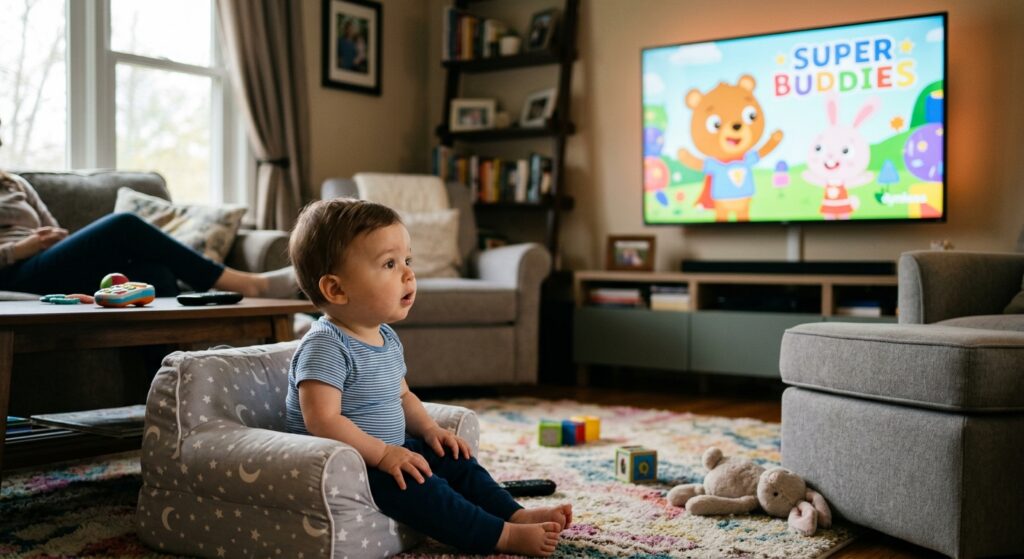
For years now, the American Academy of Pediatrics has held that kids under 18 months shouldn’t get any screen time at all, aside from video chatting with grandparents or other family. They’ve reaffirmed that stance more than once since, most recently as part of a broader 2026 update to their media guidelines that moved away from rigid time limits for older kids in favor of families building their own media plan. But the reasoning behind the under-2 guidance hasn’t changed: those early months are a critical window for brain development, one that depends on real interaction with people and objects, not a screen. The AAP has also been clear it doesn’t want TV (screen time for babies and toddlers) becoming an electronic babysitter.
Guidelines Rarely Fit Real Life
I wouldn’t argue that using television as a full time stand-in caretaker for infants and toddlers is a good idea. But everything is relative. In a family living at or below the poverty level, where parents simply aren’t available to give their kids the attention they’d like to, is it better to leave a child isolated, or to risk a parent becoming enraged because the child is too demanding of attention they don’t have to give? In that situation, some exposure to the language stimulation and educational content now available on TV might actually be a plus. My point is that it’s usually too simple to write guidelines without addressing the wide range of life situations that affect child development. If the AAP, or anyone else who claims to care about kids, really wanted to move the needle on how children grow up, they’d be focused on stamping out poverty. Growing up poor is overwhelmingly the best predictor of a hard life. Socioeconomic class matters more than almost anything else in how a child’s life turns out.
This Isn’t About Whether TV Is “Bad”
But this article is about infants watching TV, and the parents reading it are predominantly not poor. Most parents read to their kids and play with them plenty. What they don’t need is one more thing to feel guilty about. So is including some TV in a young child’s routine a bad thing? My honest answer: like almost everything else in parenting, only if it’s overdone. But what actually counts as too much? Does the content matter? Is watching TV really as passive as it sounds?
Trust Your Instincts
Parents need to rely on their own read of their child, because what’s fine for one kid may not be for another. A young child who’s active, curious, responsive, and developing on track is probably doing just fine whether he watches 30 minutes or 90 minutes of TV a day. A child showing some lag in language or motor skills probably needs more human interaction and less passive time. And notice I said human interaction, not just parent interaction. Young kids benefit from time with siblings, peers, and other caregiving adults too. Research on early day care has shown real positive effects on social and intellectual development that come from interacting with more people, not fewer. Our society sorely lacks access to quality day care, and that’s arguably a bigger gap than screen time.
“Good Enough” Parenting Is Still Good Parenting
I’m not arguing against the importance of family interaction. But I do worry that parents have become too focused on trying to maximize their children’s intelligence instead of just building close relationships with them. Guidelines like this one rarely leave room for the idea that “good enough” parenting is, in fact, good enough. The implication is always that more interaction time equals more brain development. But I doubt that reading three books a night instead of one makes your infant three times as smart. In my experience, there’s a baseline level of interaction kids need to develop well, and anything past that is really just for the fun of it. The AAP was on much firmer ground raising concerns about school-age kids spending hours alone in their bedrooms in front of a screen, or in its past warnings about the effects of exposure to violence on TV, in movies, and in video games.
The Real Goal Is Balance
Most infants and toddlers don’t stay focused on anything for very long anyway, and the content made for young kids has improved a lot. If a parent can’t be in the room, a familiar voice on the screen can still be soothing. It really comes down to keeping a reasonable balance and building a strong connection with your child over time, and that doesn’t require inordinate amounts of hands-on time. It just means giving each child some undivided attention on a regular basis, even if the rest of the day feels like it’s held together with guilt and good intentions. It’s good for their health. It’s good for yours.
For the AAP’s current screen time recommendations for infants, see their screen time guidance for infants, and for background on the 2026 family media plan update, see this coverage of the policy change.