By KidsDirect Editorial Team
Junior year was about carrying a heavier load. Senior year is about carrying it to the finish line, and then handing most of it over. There’s real relief in that, for you and your teen both. There’s also a strange kind of pressure that shows up right when everyone expects things to ease up. Applications, financial aid, a countdown to graduation, and a teen who’s mentally halfway out the door already. Senior year asks you to do two things at once. Help your teen close this chapter well, and start loosening your grip before they even leave. This is high school senior year parent’s guide.
The Application Sprint Happens Fast
Fall of senior year moves quicker than most families expect. Early Decision and Early Action deadlines typically land around November 1st, with Regular Decision deadlines usually falling around January 1st. That means a lot of the heaviest lifting, essays, recommendation letters, test score sends, happens in a tight window. It lands right as senior year is just getting started. If your teen has been putting off the essay, this is the moment to gently push rather than nag.
You don’t need to write anything or edit every draft. What helps more is keeping the logistics visible. Try a shared calendar with deadlines and a simple checklist of what each school requires. Different schools want different things, and it’s easy for a tired senior to miss a supplemental essay or a portal login buried in an email.
FAFSA Timing Actually Matters
The FAFSA for the 2027 to 2028 school year is expected to open October 1, 2026. Filing early is worth more than most families realize. Plenty of state and institutional aid gets awarded on a first come basis. Two families with identical finances can end up with different aid packages depending on when they filed. It’s worth double checking the exact opening date closer to the fall, since federal timelines occasionally shift.
Get the paperwork ready before the form opens rather than after. Both you and your teen will need an FSA ID account. Identity verification can take a few days to clear. Pull together the prior year’s tax information ahead of time too. None of this is complicated, it just goes faster when nothing is a surprise on day one.
The Real Risk Behind Senioritis
Every senior class jokes about senioritis, and a little coasting after years of hard work is normal. What’s worth knowing is that colleges do check final grades, and the consequences are real when things slip too far. This high school senior year parent’s guide uses the University of Minnesota’s admissions office as an example, they put it plainly. A real decline in senior year performance can trigger a second look at the offer. In some cases, that means a full cancellation. Final transcripts are typically due around July 1st, well after most students have already committed and put down a deposit.
That gap between decision and consequence is exactly why senioritis can catch families off guard. The grade drop happens in the spring. The problem doesn’t show up until summer, when there’s a lot less room to fix it. A C or two from burnout is rarely the issue. A full letdown across multiple classes is what tends to trigger a second look.
The Waiting Is Its Own Kind of Hard
Once applications are in, there’s a stretch of months with nothing left to do but wait. That waiting is genuinely stressful for a lot of seniors. Decisions roll out on different timelines, and social media makes every acceptance and rejection feel public. Try not to check portals more often than your teen does, and resist the urge to ask for updates every single day.
Keep senior year from becoming only about admissions news. A rejection from one school isn’t a verdict on your teen as a person. It can feel that way in the moment, but it isn’t true. Our guide on helping your teen deal with high school stress covers a lot of ground that applies here too.
College Isn’t the Only Path, and That’s Worth Saying Out Loud
It’s easy for senior year to feel like it’s entirely about the college process, especially once applications are in motion. It’s worth remembering only a small share of graduates take a gap year, somewhere around 2 percent by most estimates. Plenty of others head straight into trade programs, the workforce, or the military instead of a four year degree. None of those paths is a fallback. They’re just different roads that deserve the same respect as any acceptance letter.
If your senior is genuinely unsure what comes next, that uncertainty is normal, not a red flag. Our guide on preparing your teen for life after high school covers the real world skills worth building this year. It applies regardless of which path they choose.
Letting Go a Little at a Time
Somewhere in the middle of applications and deadlines, senior year is also the last real stretch to hand off responsibility. You’re still close enough to catch a stumble if one happens. Managing their own money. Keeping track of their own appointments. Handling a conflict with a teacher or a boss without you stepping in first. All of it matters more now than it did junior year.
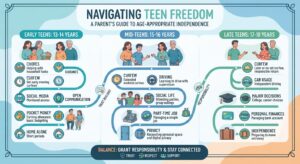
This isn’t about backing off completely. It’s about shifting from managing things for your teen to being the person they check in with. Our guide on how much freedom a teen should have is worth one more read this year. The honest answer keeps shifting right up until graduation.
What This Year Actually Asks of You
Senior year hands parents a strange mix of pride, stress, and a countdown clock they didn’t ask for. Try to hold onto the ordinary moments too, not just the milestones. A regular Tuesday dinner matters more than it seems like it should once there’s a specific number of them left.
Keep the logistics organized without taking them over completely. Let your teen feel the weight of real deadlines while knowing you’re still there if something goes sideways. That balance is really what senior year is teaching both of you at once. It’s how to close one chapter well, and trust the next one enough to let it start.
This guide wraps up our four year series for parents. Catch up with the Freshman Year, Sophomore Year, and Junior Year guides if you missed any of them along the way.