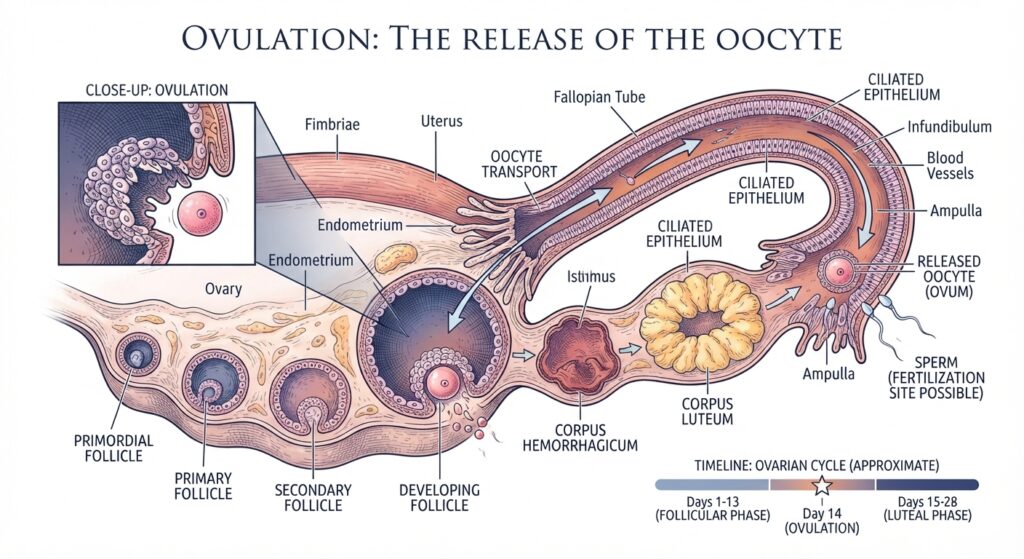
Ovulation is when one mature egg gets released from an ovary, and it's the event your whole cycle is really built around. For most women this happens roughly two weeks before their next period starts, though the exact timing shifts depending on how long your own cycle runs. Once that egg is released, it travels down the fallopian tube, and sperm has about 12 to 24 hours to reach it before the window closes.
Ways to Find Your Most Fertile Days
A few different approaches can help you narrow down when you're most likely to conceive. None of them require anything complicated.
- Use our Ovulation Calculator for a quick personalized estimate
- Chart your basal body temperature
- Track changes in your cervical mucus
- Count backward from your next period using the calendar method
Basal Body Temperature
Basal body temperature is just your body's temperature at rest, measured the moment you wake up, before you even sit up in bed. For most women that resting temperature sits somewhere between 96 and 98 degrees before ovulation, according to Cleveland Clinic. A basal thermometer, which measures in tenths of a degree, gives you the most accurate reading, though a regular digital thermometer works in a pinch. You'll find either one at most pharmacies or superstores. Start taking your temperature on the first day of your period so your chart has a full picture from the start.
Right around ovulation, your temperature rises by about 0.4 to 1.0 degrees over a day or two. That rise sticks around until your next period starts, unless you're pregnant, in which case it stays elevated for weeks. You're most fertile on the day of that temperature spike and the few days leading up to it. Some fertility experts note you can still conceive if you have sex within 12 to 24 hours after the shift, though your odds drop quickly after that. If your temperature falls right before your period is due, that's a sign you're not pregnant this cycle. Our basal body temperature chart makes it easy to track the pattern over time.
Cervical Mucus
Cervical mucus changes right along with your hormones, and paying attention to it tells you a lot about where you are in your cycle. You can check it with clean fingers or a piece of toilet paper. On the days you're least fertile, it's usually light or sticky, similar to the texture of cooked sticky rice. As you get closer to ovulation, it turns clearer, slicker, and stretchier, close to the consistency of raw egg white. The last day you notice mucus like that is usually your most fertile day, and ovulation typically follows either that same day or the day after.
Calendar Counting
This method just means doing some math with a calendar. Look at when your next period is due and count back 12 to 14 days. That range is roughly when you're ovulating, according to Johns Hopkins Medicine, and your fertile window stretches across the five days before that plus the day itself. The catch is that this only works if you already know how long your cycle usually runs, and it gets a lot less reliable if your cycle varies from month to month. If counting by hand sounds tedious, our Ovulation Calculator does the math for you.
Ovulation Prediction Kits
These kits work by picking up on a surge in luteinizing hormone, or LH, in your urine right before ovulation. To use one well, you need a rough idea of your cycle length and when ovulation is likely to happen, so you know which days to actually test. Pairing a prediction kit with a temperature chart works well. Use the chart to narrow down your fertile window, then use the kit to confirm it in real time. Like basal thermometers, these kits are easy to find at pharmacies and superstores.
Picking the right doctor matters too. If you're pregnant or thinking about it, having a primary caregiver you actually trust makes a real difference, and research consistently shows that early, steady prenatal care benefits both you and your baby. Whether that's an OB/GYN or a nurse-midwife comes down to personal preference. Our guide on picking the right caregiver for your baby's birth walks through how to choose.
Have more questions? Things like how long it typically takes to get pregnant, whether your hips actually get wider afterward, and how to know for sure you're ovulating all come up constantly. Our Pregnancy FAQ covers those and plenty more.