By KidsDirect Editorial Team
Learning Disabilities
Maybe your child works twice as hard as everyone else on homework and still comes up short. Maybe reading feels like a fight, or the backpack looks like a tornado hit it every single day. It’s easy to blame laziness or a bad attitude, and plenty of kids hear exactly that. But a learning disability has nothing to do with intelligence or effort. It’s a difference in how the brain takes in, sorts, stores, or uses information. Many children with learning disabilities are bright, curious, and creative. They just need to be taught in a way that fits how their brains work.
You’re far from alone if you’re in this spot. In the 2022 to 2023 school year, 7.5 million students ages 3 to 21 received special education services. That’s about 15 percent of all public school students. Specific learning disabilities made up the largest group, at 32 percent. This page pulls together our articles on the topic and walks through the basics of spotting a problem and getting help.
Signs Worth Paying Attention To
Every child learns at a different pace, so one slow week doesn’t mean anything. .What you’re watching for is a pattern that sticks around. In the preschool years, that could be trouble learning letters, rhymes, or the days of the week, or a late start with talking. In the early grades, watch for a child who struggles to sound out words. Another sign is mixing up letters and numbers long after classmates have stopped. Some kids can’t seem to remember math facts, even after lots of practice. These are learning disabilities in children
Older kids may read slowly and avoid reading out loud. They might have messy handwriting that tires their hand out. Putting thoughts into writing can be tough, and so can following multistep directions. Some kids try to hide it by acting out, joking around, or insisting they don’t care. A child who suddenly dreads school may be telling you something about class. So might frequent stomachaches on school mornings. Trust your gut. You know your child better than any checklist does.
The Different Types of Learning Disabilities
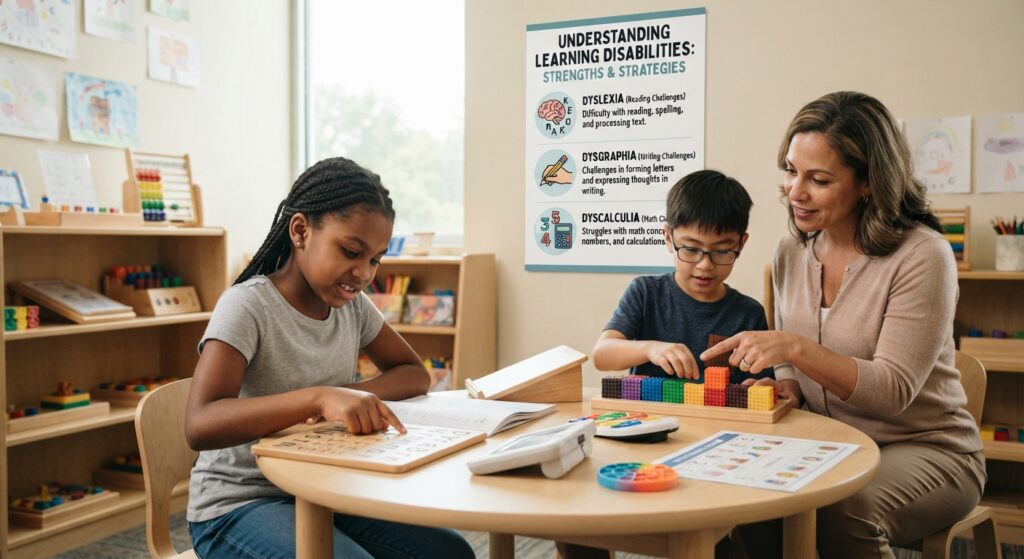
Learning disabilities aren’t one thing. Dyslexia affects reading and spelling, and it’s the best known of the group. Dysgraphia makes the physical act of writing and organizing written work hard. Dyscalculia gets in the way of understanding numbers and math concepts. Other children have trouble processing what they hear or see, even though their hearing and vision check out fine. A child can have more than one at once, which is part of why the picture can feel confusing.
Our article Are There Different Types of Learning Disabilities? breaks down each type, including attention disorders, and what each one tends to look like at home and in the classroom.
Where ADHD Fits In
Attention deficit hyperactivity disorder isn’t technically a learning disability, but the two often travel together and can look alike. A child who can’t sit still or blurts out answers may be struggling with ADHD, a learning disability, or both. ADHD is common. The CDC estimates that about 7 million U.S. children ages 3 to 17, or 11.7 percent, have a current ADHD diagnosis, based on 2024 survey data. Many of those kids also have another condition, such as anxiety or a behavior problem, so a careful evaluation matters.
Many childhood conditions slip past parents and teachers. ADHD tends to get noticed because it’s hard to miss in a classroom. Our article This Child Needs Help, Attention Deficit Hyperactivity Disorder explains the symptoms, how it’s diagnosed, and what parents can do.
What Causes Learning Disabilities
One of the first questions most parents ask is “Why? What went wrong?” Here’s the short answer. Nothing you did caused it. Learning disabilities come from differences in how the brain develops and works, and they often run in families. Certain things during pregnancy and early life are also linked to a higher chance. These include premature birth, a very low birth weight, early exposure to lead, and a serious head injury. Poor parenting, too much screen time, and not trying hard enough are not on that list.
Understanding the cause won’t change your child’s day to day needs, but it can ease some of the guilt. Our article What Causes Learning Disabilities goes deeper into the research and the factors involved.
Helping Your Child Stay Organized
Poor planning, impulsive behavior, and disorganization wear everyone down, kids and parents both. A few small habits can lower the temperature at home. Keep a single spot for the backpack and school papers. Use a picture or written checklist for the morning routine. A child can follow a list far more easily than a string of spoken reminders. Break homework into small chunks with short breaks in between. A timer gives “just ten more minutes” an actual end point. Give one direction at a time and ask your child to repeat it back.
Praise effort and progress, not just results. A child who hears only what went wrong stops trying. Our article 12 Tips for Unorganized Kids has a longer list of ideas. They help your child, and they help you stay patient too.
Getting Your Child Evaluated
If the signs add up, start with a talk with your child’s teacher and your pediatrician. Then put a request for an evaluation in writing and send it to the school principal or the district’s special education director. Keep a copy. Under federal law, the school district pays for the evaluation. The Learning Disabilities Association of America notes that the standard timeline is 60 days. Some states set their own deadlines. If you disagree with the school’s results, you can ask for an independent evaluation.
If your child qualifies, the school team writes an Individualized Education Program, usually called an IEP. It spells out the goals, services, and supports your child will get. Children who don’t qualify for special education may still get help through a Section 504 plan. It provides accommodations like extra time on tests or a quiet place to work. Either way, you’re an equal member of the team. Ask questions, bring your notes, and don’t be afraid to say you need something explained again. You can find more on school topics in our school section.
Keep the Focus on Strengths
A learning disability is one part of who your child is. It isn’t the whole picture. Kids who feel understood, and who know what they’re good at, are far more likely to keep going when school gets hard. Talk with your child about how their brain works in plain, kind words. Many people with learning disabilities grow up to be successful adults. They often learned early how to find their own way around a problem. With the right support, your child can do the same.