By KidsDirect Editorial Team
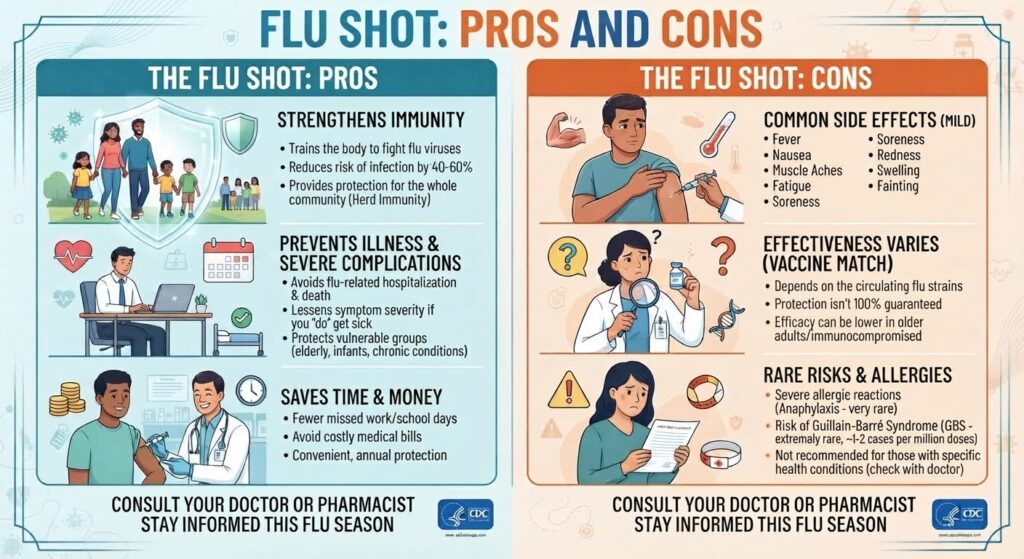
Every fall, someone posts some version of “flu season always shows up right on schedule, almost like the virus checked a calendar first.” It’s a decent bit. It’s also not actually a mystery. Cold weather pushes everyone indoors for months. They end up breathing the same recycled air, and flu viruses happen to survive longer in cold, dry air than warm, humid air. No secret scheduling committee required, just basic virus biology and a lot of closed windows. It does, however come with Flu Shots Pros & Cons.
Flu season also drags the same batch of flu shot myths back out every single year. So let’s actually run through them using this year’s numbers instead of vibes.
Let’s take a look at the common flu symptoms:
Here are the side effects from FLU SHOT (according to CDC):
- Fever
- Nausea
- Muscle Aches
- Fatigue
- Soreness
- Redness
- Swelling
- Fainting
These symptoms sound an a lot like the actual flu! I just love how everyone who gets the flu shot miraculously comes down with the exact flu they were trying to avoid.
Wait, Did My Flu Shot Give Me the Flu?
Yes, no, maybe? A flu shot physically cannot give you the flu, and the CDC is blunt about it. Except that the standard shot can give you all of these symptoms: Fever, Nausea, Muscle Aches,
Fatigue, Soreness, Redness, Swelling and Fainting
The shot actually uses either killed virus or a single viral protein. Neither one can infect you or replicate in your body, but it seems so with those symptoms. The nasal spray version uses a weakened live virus, but it’s engineered to only survive at the cooler temperature inside your nose. It can’t take hold in the warmer temperature of your lungs, so it can’t turn into an actual infection either.
What you’re feeling afterward is your immune system doing exactly what it’s supposed to do. Soreness at the injection site, a mild headache, some fatigue, maybe a low fever for a day. That’s inflammation and antibody production, not influenza. It usually clears up within a day or two. That’s a lot shorter than the week or more you’d lose to an actual flu infection. As a bonus, thimerosal hasn’t been in the mix either. Federal health officials pulled it from every remaining US flu vaccine vial back in 2025, so that’s one worry you can cross off the list entirely.
Why Bother Testing for the Flu at All?
This one actually has a real answer, and it’s not just paperwork for the sake of paperwork. Antiviral medications like Tamiflu only meaningfully shorten your illness when you start them within about 48 hours of symptoms showing up. Sooner is better than later. Waiting to see if you feel better on your own, then getting tested on day five, misses that window entirely.
Testing matters most for people where flu can actually turn dangerous. That’s anyone 65 and older, kids under 2, pregnant women, and anyone with a chronic condition like asthma or diabetes. For someone young and healthy, sure, rest and fluids might be the whole plan either way. But a test is also how your doctor rules out something else treatable. It’s also how a household figures out whether everyone else who was just exposed should start a preventive dose too.
What About the Scary Rare Side Effects?
Serious reactions exist, and pretending otherwise wouldn’t be honest, but there are flu shots pros & cons. Severe allergic reactions happen, though genuinely rarely. Guillain-Barré syndrome is a nerve condition that can cause temporary weakness or paralysis. It shows up in roughly one to three extra cases per million flu vaccinations, on top of an already tiny baseline rate that has nothing to do with vaccines at all. According to data tracked by the CDC and public health agencies, when an increased risk has been observed, it is estimated at roughly 1 to 2 additional cases per million doses of the flu vaccine administered.
To put that into perspective:
-
Background Risk: GBS happens naturally in the general population anyway, independent of any vaccines, affecting roughly 3 to 6 thousand people in the U.S. every year (about 1 to 2 cases per 100,000 people annually).
So How Well Does the Flu Shot Actually Work This Year?
Honestly, it depends on the year, and nobody at the CDC is pretending otherwise. Effectiveness hinges on how closely the vaccine matches whatever strain ends up dominating that season. Last season was a rough one. An H3N2 strain known as subclade K drifted after the vaccine formula had already been locked in. That dragged effectiveness for preventing a doctor’s visit down to somewhere between 22 and 36 percent, depending on age group. Even then, it still cut the risk of hospitalization by roughly 30 to 41 percent, which is far from nothing.
This year’s shot was specifically built to target that same subclade K strain, so the match should be tighter. There’s also a new mRNA flu vaccine option available for adults over 50 this season, using similar technology to the COVID vaccines. Early trial data has it outperforming the standard shot on most measures, with side effects that are typically mild and gone within a day.
They admit vaccine effectiveness is a moving target—hinging on your age, health, and how well it matches the current strain. Even with a perfect match, protection isn’t guaranteed. Funny how that works, isn’t it?
The flu shot isn’t infallible, and common myths usually stem from somewhere. Even so, it physically cannot give you the flu, but it can give you all of these symptoms: Fever, Nausea, Muscle Aches,
Fatigue, Soreness, Redness, Swelling and Fainting, which mimic’s the flu.
-
For a complete breakdown, check out our flu vaccine guide.
-
Unpack more frequent misconceptions in our vaccine FAQ.
-
View the full schedule in our vaccine timeline.