By KidsDirect Editorial Team
Understanding the Different Types of Learning Disabilities
One of the first questions parents ask when they learn their child has a learning disability is “Why? What went wrong?” There’s rarely a simple answer, and that’s really the point of this article. Learning disabilities aren’t one condition with one cause. They’re a whole category of different diagnoses, each with its own pattern. Figuring out which one you’re dealing with is the first real step toward getting your child the right kind of help. If you’re curious about the origins, our article on what causes learning disabilities covers what researchers know so far.
Not a Single Diagnosis
“Learning disability” isn’t a diagnosis the way chickenpox is. Chickenpox has one known cause and a predictable set of symptoms. Learning disabilities don’t work like that. The term covers a wide range of causes, symptoms, and outcomes. That’s part of why they can be tricky to diagnose, and why there’s no pill or quick fix that makes them go away.
It’s also worth saying plainly that not every learning struggle is a learning disability. Kids develop at different speeds. What looks like a red flag at age five sometimes turns out to be ordinary variation that evens out with time. A real diagnosis means meeting specific clinical criteria, not just falling behind for a stretch.
Those criteria come from the Diagnostic and Statistical Manual of Mental Disorders, now in its fifth edition text revision and usually called the DSM-5-TR. Clinicians and insurance companies both rely on it, and it looks quite different from the version your parents’ generation knew. Plenty of older material online still uses categories the DSM replaced back in 2013. Here’s what the current picture looks like.
Communication Disorders
Speech and language struggles are often the earliest sign that something’s going on developmentally. Kids with a communication disorder may have trouble making speech sounds, using language to express themselves, or understanding what others say. The American Psychiatric Association lists four of them.
Speech Sound Disorder covers kids who have ongoing trouble physically producing certain sounds, well past the age when most children have grown out of it. A little mixing up of sounds is completely normal in preschoolers. It becomes a concern when speech still isn’t clear by around age four, and most speech sounds should come out clearly by age seven. Speech therapy works well here, and most kids make real progress.
Language Disorder describes ongoing difficulty learning or using language itself. It might show up as a small vocabulary, trouble building sentences, or trouble following what people say. This is more common than many parents realize. The American Speech-Language-Hearing Association’s review of the research points to somewhere around 7 percent of children, which works out to a kid or two in an average classroom.
Childhood Onset Fluency Disorder is the formal name for stuttering. It usually begins between ages two and seven. Most kids outgrow it, but for an estimated 3 million people in the U.S., stuttering continues into adulthood.
Social (Pragmatic) Communication Disorder is a newer diagnosis. It’s for kids who can produce speech just fine but struggle with the unwritten rules of conversation. That includes taking turns, reading a room, and keeping a back and forth going with a friend.
Specific Learning Disorder
The DSM-5-TR made a real change here. It used to treat reading, writing, and math disabilities as three separate diagnoses. Today they all fall under one umbrella called Specific Learning Disorder, or SLD. A specifier then names which academic area is affected. The old terms didn’t disappear. They just changed jobs, from standalone diagnoses to descriptive labels within SLD.
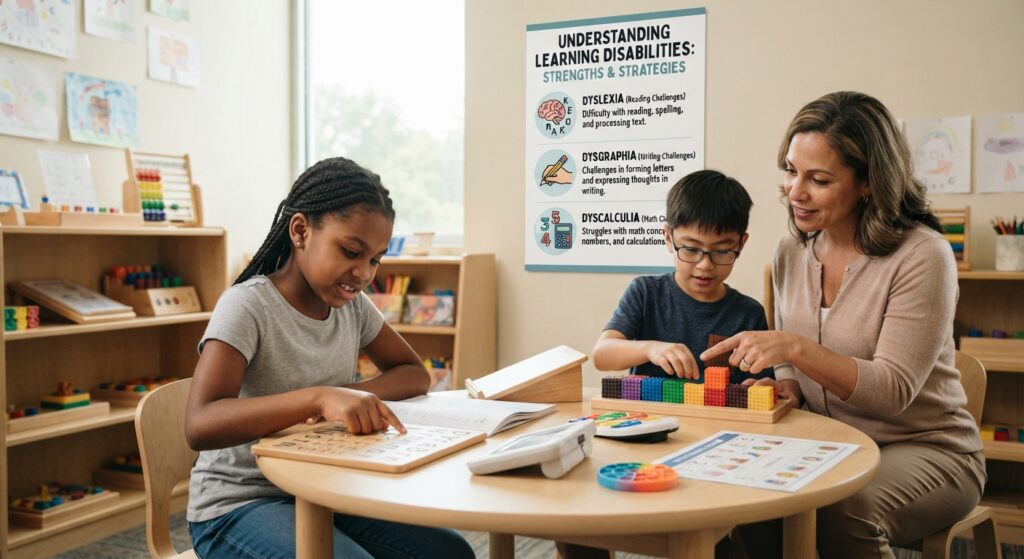
SLD with impairment in reading is still widely known as dyslexia, and it’s the most common form by far. It shows up as trouble with accurate or fluent word reading, and often with spelling and comprehension too. Reading is a surprisingly demanding job. Your brain has to track the print, match letters to sounds, parse grammar, build meaning, and hold all of it in memory at once. That takes a well coordinated network across several brain regions. Many kids with dyslexia struggle to hear and separate the individual sounds within words, a skill called phonemic awareness. It’s exactly what evidence based reading programs now target.
SLD with impairment in written expression is sometimes called dysgraphia. It affects spelling, grammar, punctuation, or a child’s ability to organize thoughts clearly on paper. It uses many of the same brain systems as reading and speech, so it often overlaps with them.
SLD with impairment in mathematics is sometimes called dyscalculia. It affects a child’s sense of numbers, memory for math facts, or grasp of ideas like place value and fractions. Trouble that shows up early usually centers on number sense itself. Trouble that appears in later grades is more often about reasoning through multistep problems.
All told, an estimated 5 to 15 percent of school age children have some form of Specific Learning Disorder. Reading impairment makes up the large majority of those cases, about 80 percent.
Motor and Other Developmental Disorders
A separate category covers kids whose coordination lags well behind what’s typical for their age. Handwriting, using scissors, riding a bike, or catching a ball can be noticeably harder for them than for their peers. This is now called Developmental Coordination Disorder, sometimes still called dyspraxia, and it affects about 6 percent of school age children. It’s no longer classified as a learning disorder, but it can make school harder, especially anything that involves handwriting.
Attention Deficit Hyperactivity Disorder
ADHD isn’t classified as a learning disability either. The two overlap often enough, though, that it’s worth understanding both. The CDC’s most recent data show that about 11.7 percent of U.S. children ages 3 to 17, roughly 7 million kids, have a current ADHD diagnosis. Our article This Child Needs Help looks at ADHD in more depth.
Some kids with ADHD are mostly inattentive. They may seem to daydream, drift off mid conversation, or lose track of what’s going on around them. Because they aren’t disruptive, they can go unnoticed for years and get quietly passed from grade to grade without the support they need. Other kids also have hyperactivity layered on top. They act on impulse, struggle to sit still, blurt out answers, or have a hard time waiting their turn.
Boys are diagnosed at roughly twice the rate of girls, about 13 percent versus 7 percent in recent estimates. But the gap has more to do with how ADHD tends to look than with how common it is. Girls are more likely to be inattentive without much hyperactivity, so they’re easier to overlook in a classroom. Many learn to mask or work around their symptoms for years.
Girls with undiagnosed ADHD are also more likely to get an anxiety or mood diagnosis first, since those symptoms are often what finally shows. Cedars-Sinai notes that girls are typically diagnosed later than boys, sometimes by several years.
By the teen years, physical hyperactivity often settles into restlessness or fidgeting. Attention and focus difficulties frequently continue into adulthood. Adults with ADHD often describe trouble organizing tasks, following through on projects, or listening carefully in the moment.
Why These Often Overlap
Speaking, listening, reading, writing, and math all draw on overlapping brain networks. That’s why it’s common for a child to be diagnosed with more than one of these conditions at once. A child with a language disorder, for instance, often goes on to struggle with reading, since reading builds directly on spoken language. ADHD often travels alongside Specific Learning Disorder too. Attention problems make it harder to build academic skills, even when the underlying ability is there.
If any of this sounds like your child, the most useful next step is usually a formal evaluation through your child’s school or a pediatric specialist. Don’t try to guess from a list like this one. A proper evaluation shows exactly which areas need support, and that’s what opens the door to services, accommodations, and a plan that fits your child. Our main learning disabilities guide walks you through the signs, the evaluation process, and getting help at school.