By KidsDirect Editorial Team
Your Menstrual Cycle, Explained
Ask a room of women what they were told about their first period and you’ll get a lot of different stories. Some heard nothing at all. Some got a whispered talk and a box of pads. Plenty grew up with a mix of myths, embarrassment, and ads that made periods sound like an emergency. A little knowledge goes a long way here. When you understand what your body is doing each month, it’s easier to spot what’s normal, plan around it, and notice when something’s off. This guide walks through the basics, clears up some common myths, and covers when to check in with a doctor.
How the Cycle Gets Started
A baby girl is born with every egg she’ll ever have, somewhere between one and two million of them. By puberty, that number has dropped to roughly 300,000 to 400,000. Each egg sits inside its own tiny sac in the ovary, called a follicle. When puberty arrives, the body starts making hormones that wake those follicles up, a few at a time. That’s the start of the first cycle, and it will repeat, with breaks for pregnancy and breastfeeding, until menopause.
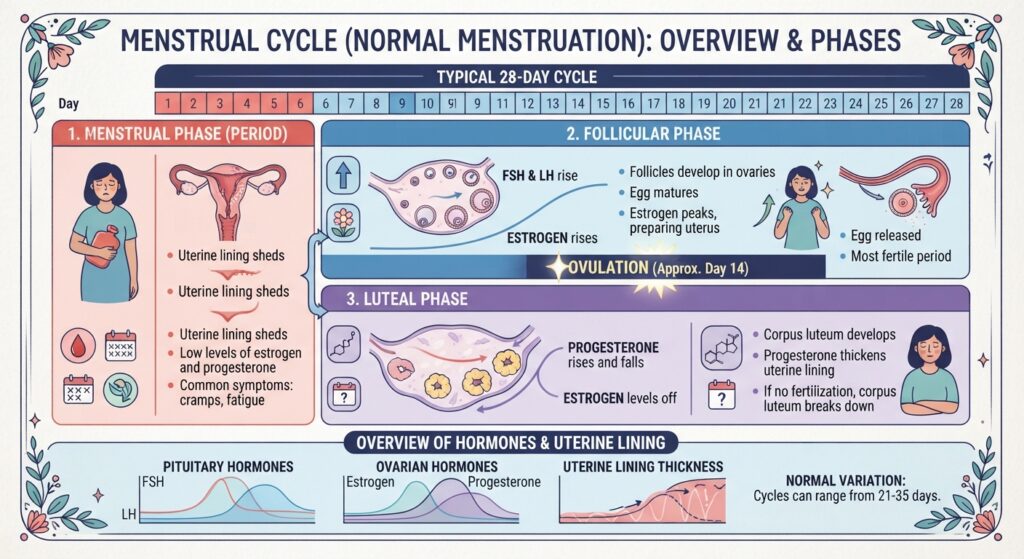
Your cycle is counted from the first day of one period to the first day of the next. Many people think of 28 days as the standard, but that’s just an average. The Office on Women’s Health describes a normal range of about 24 to 38 days, with bleeding that lasts up to eight days. Cycles in teens and people nearing menopause tend to be less predictable.
The Hormones Running the Show
Think of your brain and ovaries as a team that passes notes back and forth. It starts with the hypothalamus, a small region in the brain that helps control hunger, thirst, sleep, and hormones. It signals the pituitary gland, which then releases follicle stimulating hormone, or FSH, along with a little luteinizing hormone, or LH. Those two tell the follicles in the ovaries to start maturing.
As the follicles ripen over about a week or so, they make more and more estrogen. Estrogen thickens the lining of the uterus, which is called the endometrium, and it changes the mucus at the cervix. When estrogen hits a certain level, the brain responds with a big surge of LH. That surge pushes the most mature follicle to burst open and release its egg. Many birth control pills work by flattening that surge so no egg gets released.
Ovulation
Around ovulation, blood flow to the ovary increases, and the fallopian tube moves closer to catch the egg. Tiny hairlike structures called cilia then sweep the egg along toward the uterus. Just before ovulation, many women notice clear, stretchy cervical mucus that looks a bit like raw egg white. That mucus helps sperm swim toward the egg. Some women also feel a twinge or mild cramping on one side, and basal body temperature rises by about half a degree to a full degree right after ovulation. It stays higher until just before the next period.
The egg lives for only about 12 to 24 hours after it’s released. Sperm can survive inside the body for up to five days. That means the fertile window covers roughly the five days before ovulation, plus the day itself. If you’re trying to get pregnant, our ovulation calculator can help you estimate when that window falls. In rare cases, a fertilized egg implants in the fallopian tube instead of the uterus. This is called an ectopic pregnancy, and it’s an emergency. Sharp one sided pain, dizziness, or shoulder pain with a positive pregnancy test needs medical care right away.
After Ovulation
Once the egg is gone, the empty follicle becomes a temporary gland called the corpus luteum. It makes progesterone, which keeps the uterine lining thick and ready for a pregnancy. Estrogen and progesterone are often called female hormones, though everyone has both in different amounts. If an embryo implants, the body keeps making progesterone and your period doesn’t come. If not, the corpus luteum fades, hormone levels fall, and the lining sheds. That shedding is your period.
The second half of the cycle, from ovulation to your next period, is fairly steady for most people, usually around 12 to 14 days. The first half is where the variation lives. That’s why ovulation isn’t always on day 14, and why a longer cycle usually means a later ovulation, not a longer second half. Most people lose about two to three tablespoons of blood during a period. Losing much more than that is worth mentioning to a doctor.
Cramps and Other Sensations
Before and during a period, many women notice backache, bloating, headaches, tender breasts, loose or sluggish bowels, and mood changes. Some feel better than usual, with a burst of energy or creativity. Cramps are among the most common complaints. They come from prostaglandins, chemicals that make the uterus contract to shed its lining. Higher levels can mean stronger cramps.
For most people, simple steps help. Over the counter anti inflammatory pain relievers like ibuprofen work well, especially when taken at the first sign of cramping. Heat on the lower belly, regular exercise, and good sleep also help. Pain that keeps you home from school or work, doesn’t respond to medicine, or has gotten worse over time deserves a visit to the doctor. Conditions like endometriosis can cause severe pain and are often missed for years.
PMS and PMDD
Premenstrual syndrome, or PMS, is the cluster of physical and emotional symptoms that show up in the days before a period and fade once bleeding starts. Common ones include bloating, tender breasts, fatigue, irritability, anxiety, and cravings. According to a summary of the American College of Obstetricians and Gynecologists guideline, up to 90 percent of women notice at least one premenstrual symptom, and about 20 to 30 percent meet the criteria for PMS.
A small group, roughly 2 to 5 percent, has premenstrual dysphoric disorder, or PMDD. It brings severe mood symptoms that get in the way of daily life. PMS and PMDD are real medical conditions, not signs of weakness or poor nutrition. Regular exercise, enough sleep, and balanced meals help many people. For stronger symptoms, doctors may recommend therapy, certain antidepressants, or hormonal birth control. If your symptoms are hurting your relationships or your work, it’s worth getting help.
Period Myths, Cleared Up
Not every cycle is 28 days. Not every person bleeds every month, and not every cycle includes ovulation. Many healthy women have occasional long or short cycles. Frequent irregularity can sometimes point to something like a thyroid problem or polycystic ovary syndrome, so mention it to your doctor. Bleeding doesn’t always mean you aren’t pregnant either. Light bleeding can happen in early pregnancy, and it’s easy to mistake for a period.
Another common myth says you can’t get pregnant during your period. It’s less likely, but it can happen. Sperm can live for days, so a woman with a short cycle might ovulate soon after her period ends. That makes pregnancy possible after sex near the end of bleeding. Our due date calculator is handy once you do get that positive test.
Period Products
There are more choices than ever. Pads and tampons are the classics. Menstrual cups, which are small flexible cups made of medical grade silicone, collect flow instead of absorbing it, and you can reuse them for years. Period underwear and washable cloth pads are other reusable options. Pick whatever feels comfortable and fits your life.
If you use tampons, follow the FDA’s advice. Change them every four to eight hours, choose the lowest absorbency that handles your flow, and never leave one in longer than eight hours. This lowers the chance of toxic shock syndrome, a rare but serious infection. Sudden high fever, vomiting, a sunburn like rash, or dizziness during or after your period calls for emergency care right away.
Menopause
Menopause is officially the point at which you’ve gone 12 months without a period. In the United States, the average age is around 51. Before that comes perimenopause, which can last several years. Periods may become erratic, closer together, or further apart. Some women skip months, then have a heavy flow with large clots. Hot flashes, sleep changes, and mood swings are common. Any bleeding after menopause isn’t normal and needs a doctor’s visit.
Is the Moon Behind Your Cycle?
It’s a lovely idea. A lunar cycle lasts about 29 days, close to a typical menstrual cycle, and many cultures tied menstruation to the moon. The word “month” comes from “moon,” and menstruation shares a root with the Latin word for month. Early calendars were built on moon phases, and even today the date of Easter depends on the full moon.
The science doesn’t back up a real link, though. A large analysis of more than seven million cycles found no connection between moon phases and when periods start. The overlap is mostly coincidence. The same goes for the idea that women who live together always sync up their periods. Careful studies haven’t found that either. Many traditions did treat menstruation with reverence, while others treated it as a taboo. Today, we can respect the history and still rely on the evidence.
When to Call Your Doctor
The Office on Women’s Health suggests seeing a doctor if you miss three periods in a row and aren’t pregnant or breastfeeding, if your cycles are suddenly irregular, or if you soak through a pad or tampon every hour or two. Also call about clots bigger than a quarter, severe pain that medicine doesn’t touch, or a fever after using a tampon. Keeping a simple record of your cycle on a calendar or an app makes these conversations easier. Write down when your period starts, how heavy it is, and how you feel. Over a few months, you’ll learn your own pattern. For more on pregnancy and women’s health, browse our pregnancy section.