By KidsDirect Editorial Team
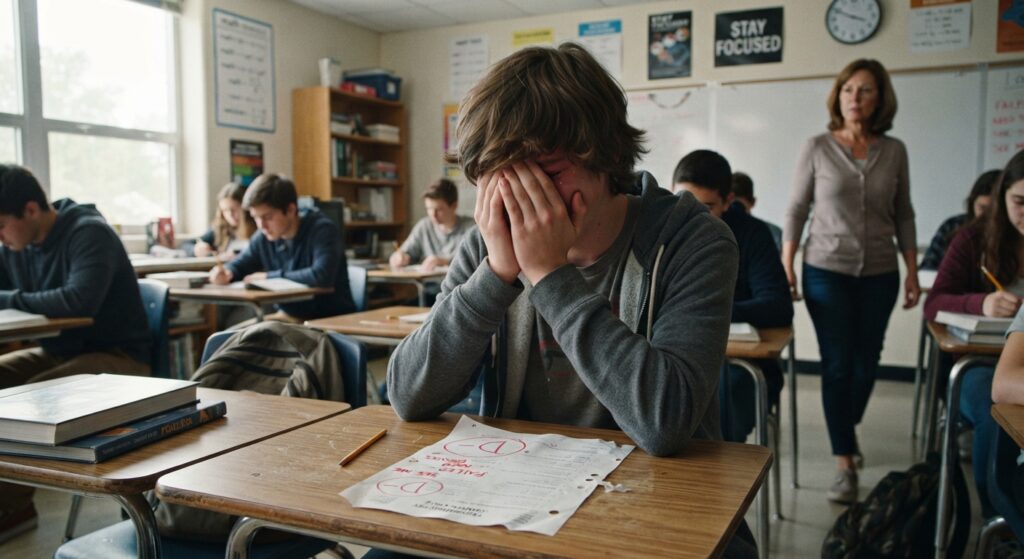
A report card comes home and it’s nothing like the last one. Maybe it’s one class that’s suddenly a disaster. Maybe it’s several at once. Your first instinct is probably somewhere between worry and frustration.
Before you land on either one, it helps to know something. A sudden grade drop almost never means your teen just stopped caring. Something specific is usually driving it. Finding that thing matters more than the grade itself.
Why a Grade Drop Is Rarely Just About the Grade
Academic decline is often the most visible symptom of something else. Sleep deprivation can do it. So can a class that’s suddenly too hard, or too easy and boring. Anxiety and depression can too. So can a rough patch with friends, a breakup, or an undiagnosed learning difference like ADHD showing up for the first time. All of these can appear first as a grade slipping.
That’s actually useful information. A grade drop is often the earliest warning sign you’ll get of something that needs attention. It’s rarely just a study habits problem to fix on its own.
This matters for how you approach it. Jumping straight to “you need to try harder” treats the symptom while leaving the actual cause untouched. It also shuts down the conversation that would help you find out what’s really going on.
Common Causes Worth Ruling In or Out
Start by thinking through a short list before you talk to your teen. That way you’ll have a sense of what to ask about, instead of going in blind.
Is your teen sleeping enough. A late bedtime paired with an early first period can chip away at focus for weeks without anyone noticing. Is a specific class too hard. If so, is that new, or has it been building. A class can also be too easy. Boredom tanks a grade almost as fast as being overwhelmed does.
Check whether anything’s shifted socially too. A friend group change, a breakup, or a falling out can quietly eat up a lot of emotional energy. Notice whether the drop is showing up in one class or across the board. A single subject usually points to something concrete, like a hard teacher or a tough unit. Trouble across several classes points toward something bigger, like mood, sleep, or attention.
According to Understood.org, a previously high performing student can also be dealing with ADHD that never got caught earlier. Some kids compensate well in easier classes. The struggle with organizing or starting tasks doesn’t show up until the workload gets heavier. That’s not a knock on your teen, or a sign anyone missed something obvious. High school demands more independent planning than middle school usually did. That’s exactly when some of these struggles surface for the first time.
Talking to Your Teen Without It Turning Into an Interrogation
How you open this conversation shapes whether you get real information or just a shrug and a closed door. Leading with the grade itself, “what happened in math,” tends to put a teen on the defensive right away. Leading with curiosity about sleep, stress, or how they’re feeling about a class tends to get further.
A teen who feels criticized right away will be less likely to tell you what’s actually going on. That’s the opposite of what you need right now.
This is the same groundwork we cover in how to talk to your teen without starting an argument, applied to a high stakes moment. Ask more than you tell. Give the conversation room to go somewhere you didn’t expect. The real answer is sometimes very different from whatever you walked in assuming.
Practical Study Strategies Worth Trying First
Once you’ve got a sense of what’s driving things, a few concrete strategies tend to help. That’s especially true when the issue is more about organization than understanding the material. Taking actual notes during class rather than just listening is one. Using a planner or a shared calendar for assignments is another. Plenty of high school struggles come down to losing track of what’s due, not a lack of ability.
Highlighting or summarizing key material while reading beats passively rereading it. Studying with a friend or a small group helps some teens stay accountable. Reaching out to the teacher directly often clears up confusion fast, even though plenty of teens hesitate to do it on their own. Our homework tips for teens covers more of this ground if the issue looks more like habits than a deeper cause.
Reaching out to teachers deserves its own mention, since it’s a step a lot of families skip. A short email asking how your teen is doing, whether they’re turning in work, and whether anything specific has come up often surfaces things a report card never will. That might be a pattern of missing homework, trouble focusing at a certain time of day, or extra help your teen never mentioned. Most teachers would rather hear from you early than find out later that a struggling student’s family had no idea.
A Few Things That Tend to Backfire
Some of the most common parent responses to a bad report card actually make things worse, even though they come from a good place. Taking away every privilege at once, phone, activities, social time, all in one sweep, often removes the very things helping your teen cope with an already stressful stretch. Activities especially matter here. Staying connected to something they care about is one of the strongest protective factors during a rough academic patch.
Comparing your teen to a sibling or a friend who’s doing better rarely motivates anyone. It almost always damages the relationship instead. Treating one bad report card as proof of a bigger character flaw, calling them lazy or irresponsible, tends to become the story your teen tells themselves too. That makes the actual problem harder to fix.
What works better is narrowing in on the specific thing that’s off, one class, one habit, one stressor. Work that piece rather than overhauling your teen’s whole life over a single report card.
Tutor, Therapist, or Just Time
Figuring out which kind of help actually fits matters. The wrong one wastes time and money without touching what’s really going on. A tutor focused on one specific class usually makes sense when the struggle is contained to that subject and seems to be about the material itself.
A school counselor or a mental health professional makes more sense when the drop shows up across multiple classes. The same goes for a drop that comes with mood changes, sleep problems, or withdrawal. Sometimes neither fits, and what’s actually needed is less pressure and more time to adjust to a harder year. That’s especially common right after the jump from middle school, something we get into more in our guide to surviving freshman year.
Keeping Their Self Worth Out of the Report Card
One of the more important things you can do here has nothing to do with strategy. Teen mental health guidance from Joon puts it plainly, make sure your teen knows their worth in your eyes isn’t riding on this semester’s grades. Emphasize effort over the raw result. Be genuinely clear that your support isn’t conditional on a specific GPA. That does more for a struggling teen than any study tip.
A teen who’s scared that bad grades will disappoint you is a teen who’s more likely to hide the next one. That’s exactly the opposite of what actually helps.
Watch for red flags that go beyond a normal rough patch. Grades dropping across several subjects at once are worth noticing. So is avoiding school altogether, a shift in mood, or sudden secrecy about grades. Take those seriously rather than assuming they’ll sort themselves out.
When to Get Outside Help
Sometimes you and your teen talk it through and still can’t land on a clear cause. Sometimes the picture that’s emerging just looks bigger than a study habits fix. Either way, it’s worth bringing in outside eyes.
A school counselor is often the easiest first step. They usually have more visibility into your teen’s day to day than you do. From there, an independent evaluation, whether for a learning difference, ADHD, or a mental health concern, can clarify things in a way that guessing at home can’t. None of this means you’ve failed to handle it yourself. It’s often exactly the piece that turns a stressful semester into a clear plan everyone can follow.
The Bigger Point
A grade drop feels urgent in the moment, and it’s fair to treat it that way. The teens who bounce back well are usually the ones whose parents treated the grade as a signal worth investigating, not a verdict worth punishing.
Find out what’s actually going on. Get the right kind of help for that specific thing. Keep the relationship steady enough that your teen keeps telling you the truth, this semester and the ones after it.