By KidsDirect Editorial Team
Freshman year was about adjusting. Sophomore year was about finding a footing. Junior year is different. This is the one where several big things land in the same twelve months. Harder classes, the PSAT, a driver’s license, maybe a first job, and the start of an actual college search. None of it waits for the others to finish first. If this is the year your house feels the most stretched, that’s not your imagination. It’s just what junior year does. This is The High School Junior Year: A Parent’s Guide.
Why This Is the Year Colleges Actually Look At
A lot of parents assume every year of high school counts equally toward college applications. That’s not quite how it works. According to College Board’s BigFuture, junior year carries more weight with admissions committees than any other year. Junior transcripts are usually the most complete record a college has when reading an application. Most students apply before senior year even wraps up. Many schools will also ask for fall semester senior grades later, but junior year is the anchor.
That’s worth saying out loud to your junior, calmly and without turning it into pressure. A rough patch in ninth grade rarely sinks anything. A rough stretch this year is the one worth catching early. If a grade starts sliding, our guide on what to do when your teen’s grades drop is worth a look. It walks through finding the actual cause instead of just pushing harder.
The PSAT Shows Up and Actually Means Something
Most students take a version of the PSAT earlier in high school as practice. Junior year is different. The PSAT/NMSQT taken this year is the one that counts toward the National Merit Scholarship Program. It’s the only year that does. According to Compass Prep, roughly 1.3 million students take the qualifying test each year. About 4 percent of them earn recognition as a Semifinalist or Commended Student. That’s a real accomplishment, but it’s also a small slice. Most kids won’t land in it, and that’s completely normal.
Where this test actually helps is as a low stakes practice run for the SAT. The score report shows exactly which question types are shaky, which is more useful than any generic study plan. Junior year is also typically when the first real SAT or ACT gets scheduled. There’s no need to have a testing calendar mapped out by October. There is a good reason to at least know the school’s testing timeline before spring gets busy.
Coursework Gets Genuinely Harder
AP and honors classes tend to pile up in junior year more than any other. Students want that rigor on record before applications go out. That’s a reasonable goal. It’s also a lot to carry at once alongside everything else happening this year. Watch for the difference between a teen who’s challenged and a teen who’s drowning. Challenged looks like frustration over one hard unit. Drowning looks like falling behind across multiple classes with no plan to catch up.
If it’s the second one, dropping a level isn’t a failure. It’s usually the smarter move. A B in a class your teen can actually keep up with tends to serve them better. A C or a D in a class that’s quietly wrecking their confidence doesn’t help anyone. Our piece on homework habits for teens is worth revisiting here too. A heavier course load usually means old habits stop being enough.
The College Search Starts, Even If the Applications Don’t
Junior year is when “someday” starts turning into an actual list. That doesn’t mean essays and applications, those mostly wait for senior fall. What it does mean is simpler than that. Campus visits when they fit into a weekend. Honest conversations about what your teen actually wants out of a school. Maybe a meeting with a school counselor to talk through the options. Keep this part low pressure for as long as you can. The High School Junior Year: A Parent’s Guide is for who feels like every conversation about the future is a test tends to shut those conversations down fast.
It also helps to widen the lens a little. Not every strong path runs through a four year degree. Treating it as the only finish line adds pressure that doesn’t need to be there. There’s plenty of time this year to explore without locking anything in.
More Independence Shows Up All at Once Too
Academics aren’t the only thing ramping up. Junior year is usually when licensing rates jump sharply. According to data from the Federal Highway Administration, about 26 percent of 16 year olds hold a license. That climbs past 60 percent by age 18, and most of the jump happens right in the middle, during junior year.
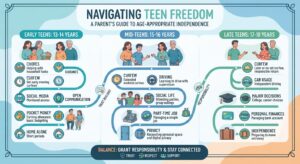
A part time job often shows up around the same time. Teen employment climbs steadily too. The Bureau of Labor Statistics puts it at over a third of that age group in a recent report. A license and a paycheck are two of the biggest trust tests you’ll hand your teen in high school. They often land the same year as the hardest classes your teen has taken yet. Our guide on how much freedom a teen should have is worth another look right about now. The answer tends to shift fast this year.
Watch the Load, Not Just the Grades
It’s easy to track grades and miss everything sitting underneath them. Junior year stacks academics, testing, a job, driving, and the college conversation on top of a normal social life. That’s a genuinely heavy load, even for a teen who’s handling it well on paper. Watch for the signs it’s tipping from manageable into too much. Sleep that keeps slipping. A mood that stays flat for weeks. A teen who’s stopped doing anything that isn’t school or work.
If that sounds familiar, our guide on helping your teen deal with high school stress covers this in more depth. It walks through where the pressure tends to come from and what actually helps. A single screen free evening or an unstructured hour on the weekend does more for stress than most parents expect.
What Actually Helps This Year
You don’t need to manage every piece of this yourself, and trying to will probably backfire. What helps more is staying close enough to notice when one part of the load is crowding out everything else. Ask about the PSAT results without turning it into a verdict. Talk about colleges the way you’d talk about any other big decision, with real curiosity instead of pressure. Notice when a new license or a new job starts eating into sleep, and say something before it becomes a pattern.
Junior year asks a lot of your teen. It’s also the year that sets up how they’ll handle senior year, when the pace picks up again. Keep the conversation open. Remind your junior that a hard year isn’t the same thing as a year gone wrong.
This guide is part of our four year series for parents. Catch up with the Freshman Year Survival Guide and the Sophomore Year Parent’s Guide if you missed them, and continue on to the Senior Year Parent’s Guide next.