By KidsDirect Editorial Team
Braxton Hicks Contractions
Your belly suddenly turns rock hard. It lasts a minute, then it’s gone. You freeze, wondering whether this is it. Most of the time, it isn’t. These squeezes are called Braxton Hicks contractions, and they’re a normal part of pregnancy. Here’s what they are, how to ease them, and how to tell when something more is going on.
What Braxton Hicks Contractions Are
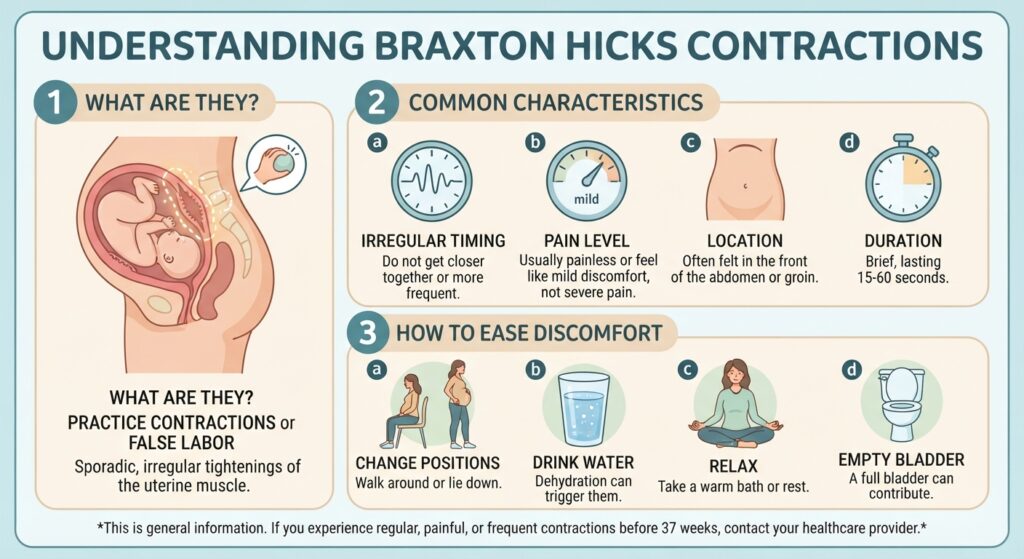
Think of them as practice runs. Your uterus is a big muscle, and like any muscle, it likes to warm up before the main event. During a Braxton Hicks contraction, the muscle tightens and then relaxes, but your cervix doesn’t open. That’s the big difference from real labor. An English doctor named John Braxton Hicks described them in 1872, and the name stuck.
When They Start
They can begin as early as the second trimester, though many people don’t notice them until about 20 weeks or later. They show up more often in the third trimester, and they tend to keep coming until labor begins. Some people feel them early and often. Others barely notice them at all. Both are normal. You can read more about what’s ahead in our overviews of the second trimester and the third trimester.
What They Feel Like
Most people describe a tightening that starts at the top of the belly and spreads down. Your belly may feel hard, like a basketball, and you might see it change shape. For many, it’s more uncomfortable than painful, though some find them sharper. They usually last 30 to 60 seconds, and sometimes up to two minutes, according to Babylist.
Here’s the key part. They’re irregular. One might come, then nothing for an hour, then two close together, then none for the rest of the day. They don’t build in strength, and they don’t settle into a steady pattern.
What Sets Them Off
Often there’s a trigger. Dehydration is the most common one. Others include a full bladder, a busy day on your feet, and sex. Your baby moving around can set one off, and so can someone touching your belly. A urinary tract infection can also bring them on, so mention frequent contractions to your provider if you also have burning when you pee.
How to Ease Them
You can usually calm them down on your own. Start by changing what you’re doing. If you’re sitting, stand up and walk around. If you’ve been on your feet, lie down on your left side and rest. Drink a big glass of water, since dehydration is the top trigger. Empty your bladder, too.
A warm bath can help, as long as you keep it to about 30 minutes or less, according to American Pregnancy Association guidance. Slow breathing helps as well. If the contractions fade after you try these things, you’re almost certainly dealing with Braxton Hicks.
How to Tell Braxton Hicks From Real Labor
The simplest test is to change what you’re doing and watch what happens. Braxton Hicks tend to ease or stop when you walk, rest, drink water, or switch positions. Real labor contractions keep coming no matter what you do.
Timing matters too. Real contractions become regular, and over hours they get longer, stronger, and closer together. Braxton Hicks stay irregular and don’t build. Where you feel it can offer a clue. Braxton Hicks are usually felt in the front of the belly, while labor pain often starts in your back and wraps around to the front. Real labor may also come with a bloody show, which is a mucus plug that comes out, or your water breaking.
When you think labor is starting, time your contractions. Our guide to the stages of labor explains the 5-1-1 rule, where you head in once contractions are about five minutes apart, last about a minute, and have kept that pattern for an hour.
Could It Be Preterm Labor
This is the one situation where you shouldn’t wait and see. If you’re less than 37 weeks pregnant and you’re having more than four to six contractions in an hour, call your provider. The same goes if they’re coming about every 10 minutes. The University of Washington’s preterm labor handout lists other warning signs, including cramps like your period, a dull low backache, pelvic pressure, and a feeling that something isn’t right.
Watery fluid leaking from your vagina, blood, or a sudden change in discharge are also reasons to call. While you wait for advice, drink some water, empty your bladder, and lie down on your left side. Calling early can make a big difference, and nobody will think you’re overreacting.
When to Call Right Away
At any point in pregnancy, get help right away if your water breaks, if you have bleeding, or if you have steady belly pain that doesn’t ease between squeezes. Call too if your baby is moving less than usual. If your contractions are regular and getting stronger, call your provider even if you’re not sure it’s labor. Stash your labor checklist by the door so you’re ready, and think through your wishes with our guide to making a birth plan.
Questions Parents Ask
Are Braxton Hicks contractions harmful to my baby?
No. They’re a normal part of pregnancy, and they don’t hurt your baby. They may feel odd to you, but they’re just your uterus warming up.
Does having them mean labor is close?
Not necessarily. You can have Braxton Hicks for weeks or even months before labor starts. They don’t open your cervix, so they can’t predict a delivery date.
Do I need to time them?
If they come every so often, no. If you aren’t sure whether you’re having real contractions, time them for an hour. Write down when each one starts and how long it lasts. Our due date calculator can help you see where you are in your pregnancy.
Can I have them early in pregnancy?
You might feel tightening in the first trimester, but it’s usually something else, like stretching or gas. If you’re having regular cramps, bleeding, or pain early on, call your provider.
Worth knowing. Every pregnancy is different, and your provider knows yours best. When something feels off, call. For more to read, browse our pregnancy section.